
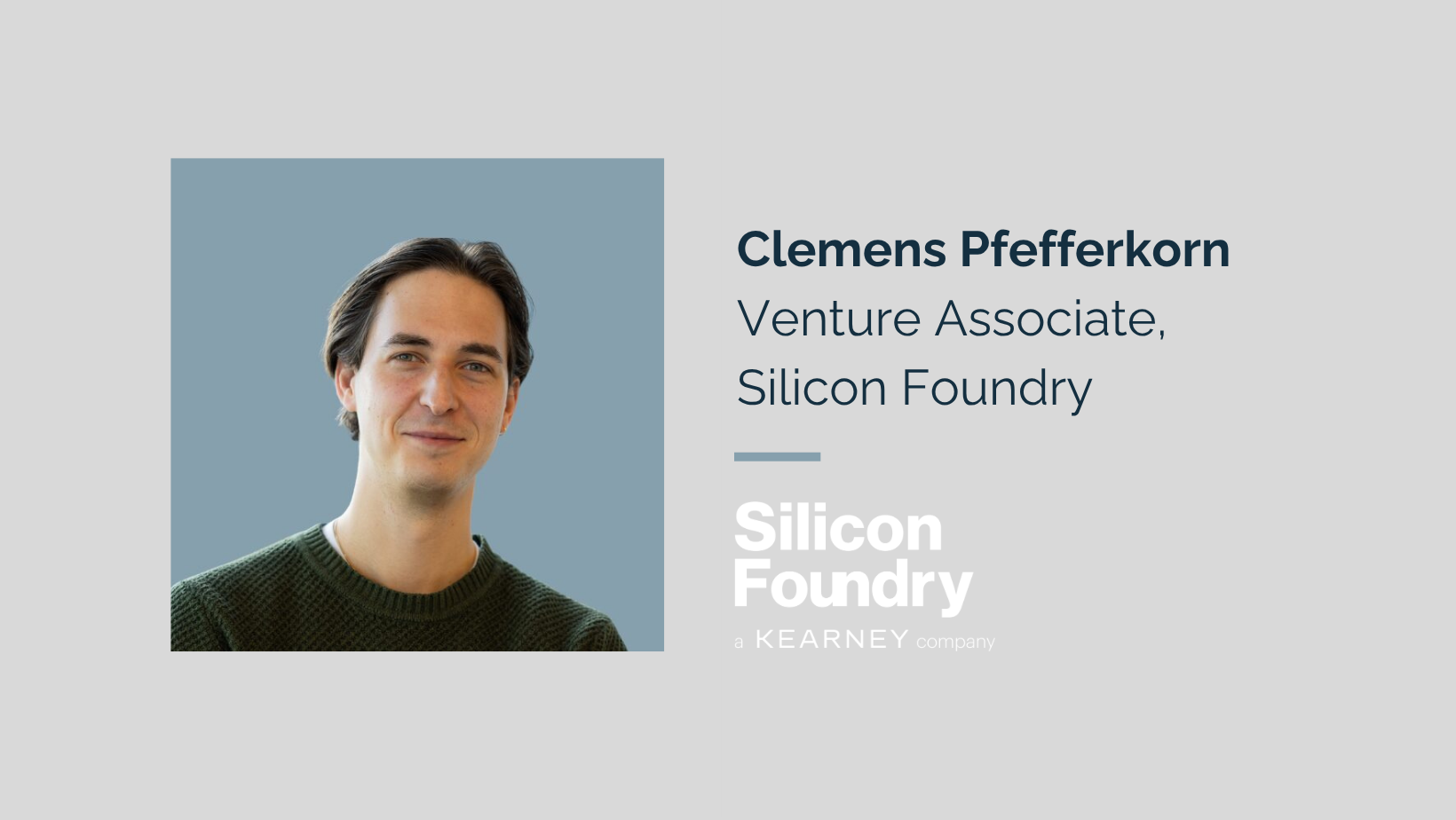
We’re pleased to introduce Clemens Pfefferkorn, who joins the Silicon Foundry team as a Venture Associate. Clemens brings experience across venture and corporate innovation, with a background at Kearney’s Innovation Competence Center (IMP3ROVE) and academic research focused on how organizations evaluate and scale startup partnerships. At Silicon Foundry, Clemens works closely with corporate leaders to identify and engage with emerging technologies, connecting strategic priorities with startup ecosystems and helping translate early innovation signals into scalable business outcomes.
Before joining Silicon Foundry, you worked at the intersection of consulting and venture, including your time at Kearney and your research on venture clienting. What key lessons have you taken away about how large enterprises can effectively source, evaluate, and integrate emerging technologies?
When I worked at Kearney, my main focus was on innovation management, so around how large corporations can manage innovation successfully to increase the success rate of their internal activities. In one of my last projects I stepped outside the internal scope and worked on the topic of supplier innovation, meaning how you can engage with suppliers to drive innovation efforts. This was super fascinating as it was my first direct touchpoint with the concept of open innovation and somehow ignited my interest.
That said, as I immersed myself into the open innovation space, I began to learn that there is something very magical about the idea, but also reality and the barriers that come with it. Open innovation isn’t a strategy you just adapt, it is a muscle that organizations have to develop and actively strengthen over time.
This belief and understanding was strengthened during my graduate studies, where I specialized in corporate venturing and social entrepreneurship. One of my key contributions to the academic landscape was a holistic analysis of how the selection criteria venture clienting units apply should change when assessing emerging vendors, as uncertainty decreases from first scouting to post pilot decisioning.
What initially drew you to venture and corporate innovation?
The story actually goes back a little further. When I was growing up, my dad was an entrepreneur, so the topic of entrepreneurship was deeply ingrained in my upbringing. At 13, I founded my first company, a bakery delivery service inspired by a book I had read. Over the summer holidays (which are about six weeks in Germany), I had two classmates actually working for me. I hired them, and while it was little money (they earned about 450 euros a month), I was making around 1,000 euros a month, which felt like a huge amount for a 13-year-old.
That early experience started my fascination with entrepreneurship. Later, during my graduate studies and an educational leave from Kearney, I had time to step back and realize that the intersection of the corporate world, which I had come to understand more deeply, and the venture world was exactly where I wanted to spend my future career.
You recently completed a Master’s program with the University of Cologne, with a class of international business students. Tell us about this experience. What were some of the most notable aspects of learning with an international cohort?
I completed the CEMS Master’s, a program offered at 30 universities worldwide, with every university in a different country, covering all six major continents (unfortunately there is no school in Antarctica yet).
It was really fascinating, because we not only studied in an international setting within our local cohort of 20+ nationalities, but we also had regular excursions and exchanges between the schools. What clearly became apparent to me is that there is no single right way of thinking. While core value systems were generally aligned across cultures, my studies reminded me every day that my whole life I had been living within a certain bubble. What stood out most were the differences in how cultures approach business models and the role of social impact as they grow business from 1 to 100.
During your time as Founders Associate at devonSport, what early lessons did you take away about working with startups that still shape how you approach venture and corporate innovation today?
The founder of devonSport had one big mantra: “kennen, machen, können.” It is German, and it roughly translates to “knowing, doing, and then actually being able to do it.” That framing really stuck with me. As a startup, you have to stay agile: once you have an idea, try it and validate it in the market. It applies both to personal skills and startup capabilities. You can only learn to do something by actually doing it.
I think this mindset is more common in large organizations, which tend to be very risk-averse. Working with ventures, driving innovation, and really moving the needle requires a willingness to learn, iterate, and fail. If you don’t fail, you don’t succeed.
What distinguishes companies that successfully translate innovation into scalable outcomes from those that struggle to move beyond experimentation?
From what I have seen, it comes down to how companies approach uncertainty. The ones that struggle tend to apply the same rigid procurement logic they use for established suppliers to startups, which just does not work. Startups do not have the track record or the operational maturity that those criteria assume, so you either reject good startups for the wrong reasons, or you put so much pressure on them that you kill the very thing that made them attractive in the first place.
The companies that get it right are the ones that treat evaluation as something that evolves with the project. Early on, when information is scarce, they lean on so-called proxies to move fast. These can be signals such as funding, team track record, and reference customers. As they learn more throughout the engagement, they shift to actual evidence: what happens in the pilot, how the team performs, how well the solution integrates. As a result, when it comes time to scale the solution, they are not starting a new evaluation but are confirming what they already know.
The other thing the winners have is internal readiness and commitment. Many pilots do not die because the technology failed, but because no one within the company was actually ready to adopt it. You need a business owner, top-level buy-in, and a clear path to scale before you even start. Without that, even a great pilot ends up in what academics call pilot purgatory.
What emerging patterns are you seeing in venture clienting and corporate-startup partnerships that are not yet fully appreciated?
Two things stand out to me.
The first is what agentic AI is doing to enterprise software. For years, the argument for buying a big suite was that integrating lots of specialized tools was too expensive and too slow. That assumption is breaking. As protocols like MCP and A2A lower integration costs, it becomes much more realistic for enterprises to stitch together best-in-class startups through an orchestration layer rather than settle for a one-size-fits-all suite. For startups, being narrow is no longer a liability. It is actually the moat.
The implication for venture clienting is that agentic readiness will become a real evaluation criterion. It does not need to exist today, but startups need a clear roadmap toward it. Most Venture Client Units are not screening for this yet, and I think in a couple of years that will look like an obvious gap.
The second pattern is more subtle. Venture clienting is often framed as a lightly modified procurement process, but I think it is becoming something more fundamental. It is positioning itself as the primary way enterprises will procure innovation in an AI-driven world. The scouting and screening layers themselves are getting faster and cheaper through tools on the market, which means the model scales in ways it did not before.
What are the industries you’re most excited to work with, and why?
A few areas have my attention right now.
The first is AI-driven consumer research. It is a space I have been delving into recently, and what excites me is that we are seeing the first real wave of tools that go beyond surveys and focus groups. AI-moderated interviews with real humans, synthetic personas, emotion AI, behavioral analytics. These are fundamentally changing how fast and how deeply companies can understand their customers. For a category that has historically been slow and expensive, this is a real step change.
The second is agentic AI as an orchestration layer. The shift from buying a single platform to orchestrating a portfolio of specialized tools will reshape how enterprises build their software stack. The startups that solve this orchestration problem well will be enormously valuable, and venture clienting is a great way for enterprises to start working with them early.
The third and final is cybersecurity as a key enabler for successful AI transformation. When talking to clients across industries it becomes more and more apparent that there is a clear momentum to accelerate agentic adoption. What also is apparent is that the holistic understanding of how to govern, secure and audit the deployed agents is often missing. I strongly believe that cyber will be on top of the radar for all of our clients in the years to come and become the strategic enabler for their agentic transformations.
More broadly, retail and industrial are the two verticals I am most drawn to. Retail sits at the intersection of consumer behavior, AI, and operational complexity, and there is still so much untapped potential in pricing, personalization, and supply chain. Industrial because the scale of the problems is enormous and the AI adoption curve is still early, which means the next few years are going to be transformative. Both are sectors where the gap between what is technically possible and what is actually deployed is still huge, and closing that gap is exactly the mandate I joined Silicon Foundry for.
What’s one piece of advice you’d give to leaders navigating today’s innovation landscape?
Build a culture where failing fast is not just tolerated, but actively celebrated. A story that always stuck with me from my time at Kearney is that Tata Steel in India used to give out a prize for the biggest failure of the year. It was tied to their internal innovation initiatives, and the logic behind it was that if your failure rate is not high enough, you are simply not trying enough. I think that mindset is more relevant today than it has ever been. The cost of prototyping and testing has dropped dramatically, and the leaders who take advantage of this will move much faster than those who are still trying to get everything right on the first attempt.
Concretely, I would give leaders a three-step approach.
First, demystify the noise. There is so much hype around AI right now that it is easy to get pulled in ten directions at once. Leaders need to cut through that and figure out what is actually relevant for their business.
Second, run rapid proofs of concept for ideas that look promising. Do not spend six months building a business case. Get something in front of real users quickly and see if the use case is actually viable.
Third, once you have validated that a use case works, then decide how you want to pursue it. You do not have to commit to a single vendor or solution just because you ran the first POC with them. That is the moment to step back and ask the bigger question: should we run a proper RFI, build something internally, or go deeper with the startup we piloted with? But that decision only makes sense once you have real evidence in hand, not before.
You recently moved from Germany to San Francisco. What excited you about living in the Bay Area? And what are some key differences you see between the innovation ecosystems in Silicon Valley and across Europe?
What excited me most about moving to the Bay Area was the ecosystem’s density. In Silicon Valley, you can have three teas (I unfortunately or luckily never got into coffee) in one day with three founders building at the absolute frontier of what is possible. The proximity to the people actually shaping where AI and technology are going is something you just cannot replicate from anywhere else in the world right now. On a personal level, I also love the lifestyle. The mix of nature, culture, and an international community has made it feel like home much faster than I expected.
In terms of the differences between the ecosystems, a few things stand out.
The first is mindset around risk and ambition. In Silicon Valley, I feel like the default question is “how big could this be?” In Europe, the default is more often “how do we make this a little better?”. I come to learn that both views have their merits, but belief the Silicon Valley mindset creates the conditions for genuinely ambitious bets, while the European mindset ensures continuous innovation.
The second is capital. The depth of the funding ecosystem here is just on a different scale. Founders can raise faster, scale faster, and take bigger swings, and that pulls in more talent, which pulls in more capital, and so on. What is amazing for me to see since joining last year, that Europe is making real progress on catching up, but the gap is still significant.
The third, and this is the one that surprised me most, is the speed of corporate adoption. Large US companies are often willing to pilot with a startup much faster than those in Europe. I strongly believe that there is still much improvement in both ecosystems, though, and am bullish that the current venture clienting trend in Europe might even enable us to push Europe ahead on this metric.
That said, Europe has real strengths that I do not want to underplay. The depth of industrial expertise, the quality of engineering talent, and the regulatory thoughtfulness around things like AI are genuine advantages. The most interesting opportunity, in my view, is connecting the two ecosystems more deeply. The startups that figure out how to combine European depth with Silicon Valley speed are going to be very hard to beat.