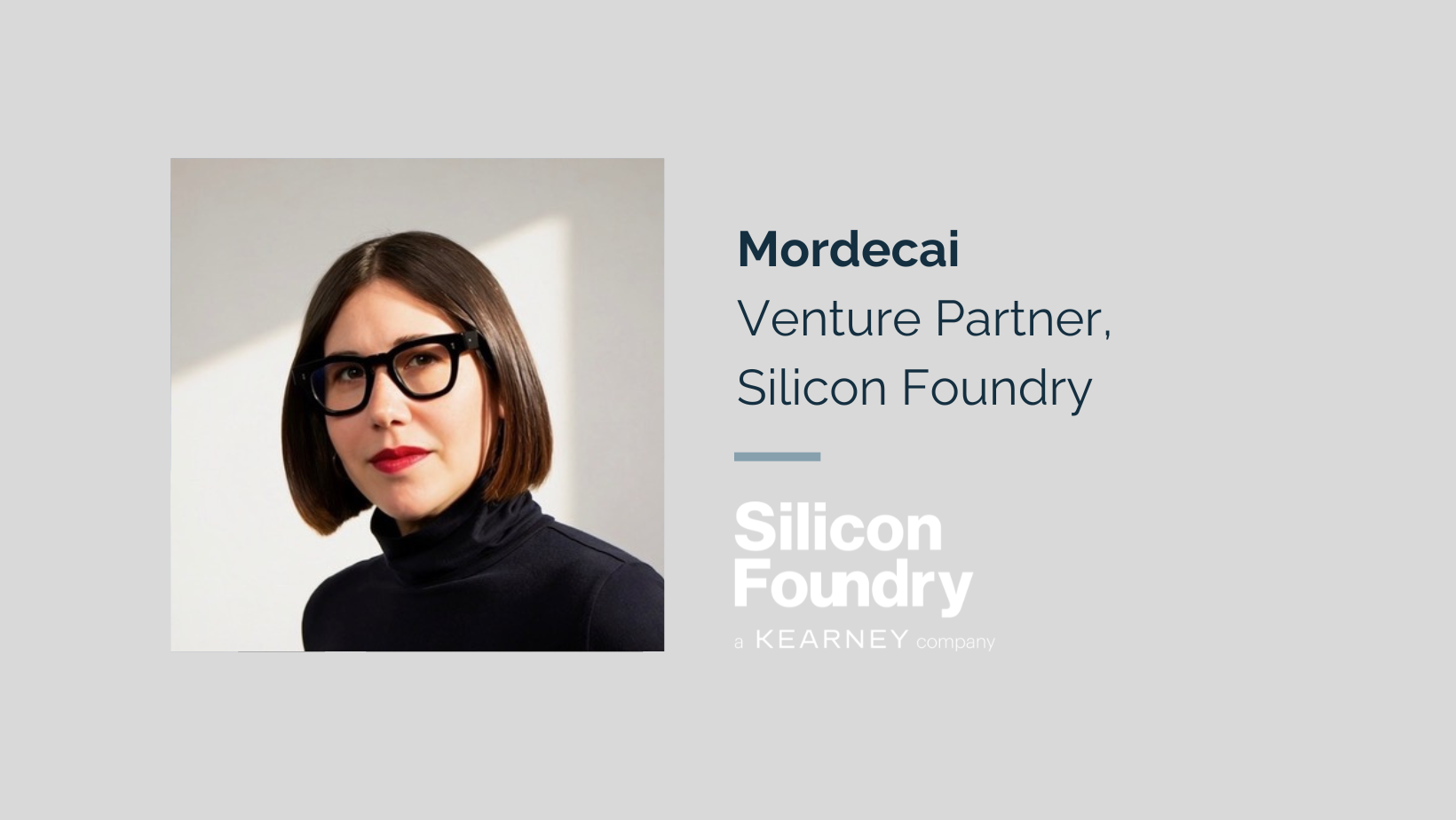
She built a profitable innovation group inside a global automaker, then wrote the playbook for the Chief Innovation Officer role at Gartner. Now she’s joining Silicon Foundry to help Members close the gap between what technology makes possible and what their organizations can actually shi
Mordecai has spent her career on both sides of the corporate innovation problem — first as the operator proving it could pay for itself, then as the analyst codifying how it should be structured. She created and ran the Innovation & Partnerships group serving Hyundai Motor Group, built Gartner’s Chief Innovation Officer practice, and advises organizations navigating transformation, growth, and disruption. She works by a credo she’s carried throughout: Hope via Disruption.
We asked her about what actually separates innovation that lands from innovation that stalls, the widening gap between AI ambition and AI execution, and what she’s most looking forward to tackling with Members.
You’ve had a rare vantage point on corporate innovation – leading innovation and partnerships for Hyundai, building Gartner’s Chief Innovation Officer practice, and now advising organizations navigating transformation, growth, and disruption. What have those different perspectives taught you about what separates companies that consistently turn innovation into business impact from those that struggle to move beyond experimentation?
My role at Hyundai was the proof, and at Gartner you got the pudding.
At Hyundai I created a profitable innovation group that reported to – and was funded by – the global board. My group delivered demonstrable business growth via new lines of business, efficiencies across the org, and profits, creating a sustainable practice for innovation. When we aren’t able to sustain a practice of innovation, innovation leaders leave and the entire group gets shuttered. That sets off a cycle where innovation always has to be newly modeled and assembled from scratch, and that’s where the struggle comes from.
When innovation is embedded, and seen as relevant as well as reliable, it makes an impact. What I created at Gartner was the foundational playbook: taking my proof of this and maximizing my tactics and learnings into client orgs. Through my frameworks and a clear definition of the leadership skills necessary, I proved that truly successful innovation in an organization is a C-suite role, reporting to the CEO or board, with measurable growth targets to demonstrate impact. That’s the line of differentiation. A great innovation leader — and this is exactly where Silicon Foundry sits — has C-level support and alignment, a clear path to action, and the knowledge to deliver outcomes.
We understand that organizations have to experiment. You won’t survive disruptive times without exploring. But experimentation is not innovation. I define innovation as “the forward application of technology, culture, and simply great ideas.” That definition requires action with momentum, not play just to see what’s possible. If we stay in experimentation with what’s often just a slush fund for innovation, it’s unaccountable and requires constant permission to go further. Innovation leadership under my model earns the capacity to play, precisely because it’s driving performance rather than experimentation alone.
Experimentation is not innovation. I define innovation as the forward application of technology, culture, and simply great ideas.
You’ve recently been exploring the widening gap between what’s technologically possible with AI and what large organizations can actually legitimize, fund, and ship. Where are you seeing that gap most acutely today – and what can innovation leaders do differently to help their organizations move from AI ambition to meaningful execution?
First and foremost, innovation leaders must remember they don’t need to reinvent fundamental governance. But they do need to accelerate the operating cadence – drastically.
This widening gap between what’s possible with AI and what’s probable in large enterprises is a hurdle innovation leaders have faced for ages. An innovation leader is the front door for emerging technologies in a company – the possible – and the translator of that technology across the business – the probable. That means there’s an operating model to pilot, position, and pivot across opportunities that may be new, more efficient, greener, cheaper, just a better look, a better headline.
Especially with the breadth of AI, you need someone who understands how to distribute opportunities, spotlight benefits, and find collective cohesion in a matrixed organization. That’s your innovation leader.
What’s most important and different here is understanding that innovation is no longer a three-to-five-year adoption roadmap. It’s one to three years if you’re lucky, and every year there will be new trainings, new updates, new solutions to adopt. You’re not just learning the rules of the game once. You’re getting new plays every quarter, and each one requires that entry point and translator to guide it through. No one is an expert. No solution will be absolute.
You’re not just learning the rules of the game once. You’re getting new plays every quarter.
Having worked at the intersection of innovation, partnerships, emerging technology, and enterprise strategy, where do you think external ecosystems — startups, technology partners, investors, and corporate peers — can create the greatest advantage for large companies today? And what do companies often get wrong about engaging those ecosystems?
During the rise of startup culture in the mid-oughts, we saw corporates quick-fill innovation as a mid-level individual contributor function, meant to bring a little of the zipper hoodie and free lunch mindset into legacy orgs. A lunch and learn with little to lose.
Now, you are only as good as your ecosystem. Corporate innovation leaders can only stay three steps ahead – quicker, more ready – with the support of their ecosystem. Ecosystems are your partners to success, bringing ready-to-discuss solutions and partnerships, creative inspiration, and new possibilities to the table. They put you on a faster track by providing learnings that mitigate risk, accelerate or decelerate scaling, and foster the principles you’ll need for adoption. Your ecosystem is your advantage.
But your ecosystem is not just for the taking. It requires trust and challenge. You have to stress test how you understand things from the corporate lens against their outlook to grasp the fuller picture.
All of which allows you to avoid the number one thing a company gets wrong in innovation today: starting from a blank page. Just as an R&D innovation leader can prompt AI for a thousand solutions as a kick start, an ecosystem-based innovation leader leverages ecosystems for their pre-vetted, real-world proof points. Leaders who can query what’s early in market at the drop of a prompt don’t need to start from nothing. If you’re thinking about it, someone else has been exploring it, even peripherally — and you need each other. Don’t go it alone.
Your ecosystem is your advantage. But your ecosystem is not just for the taking. It requires trust and challenge.
As you join Silicon Foundry as a Venture Partner, what kinds of challenges are you most excited to help our Members tackle? When a senior innovation or transformation leader comes to you with a difficult problem, what perspective or experience do you bring that can help them see the problem differently – and ultimately move forward?
Problems are simply opportunities for solutions, the same way we find Hope via Disruption — my credo. I’m most excited to support Members in tackling their execution hurdles, expanding their understanding of how a solution can be implemented, and turning what looks like an impossibility into a moving, accelerating, forward application of innovation.
Translating new technologies, startups, and thinking into legacy organizations is a careful dance. How you prioritize and operationalize innovation across an org and into a diverse array of opportunities needs experienced support. No innovation leader is an island, and having a trusted partner — which is what a Venture Partner can be for a Member — is the Swiss army knife required to realize innovation in large orgs. Support that’s nuanced and tested makes the actionable path forward easier to see and to implement.
Beyond that, as a Venture Partner I bring the disruptive thinking, enterprise understanding, and futures analysis to unlock a Member’s story for what’s ahead at their company. From new business models already on the horizon with the adoption of agentic consumers, to the futures of growing markets, I can unlock what’s possible across our ecosystem for theirs.
My goal as a Venture Partner is to translate my operator experience into immediate value for Members — whether that’s immersing innovation leaders in reliable possibilities through executive treks, or supporting pilot studio programs by prioritizing, operationalizing, and scaling with my PopOp framework. I’ll be holding the front door for them.
“No innovation leader is an island.”
Mordecai is a Venture Partner at Silicon Foundry. She created and ran the Innovation & Partnerships group serving Hyundai Motor Group, and built the Chief Innovation Officer practice at Gartner, where her coverage spanned enterprise-wide innovation leadership, innovation growth strategy, emerging trends, and agentic AI business models. She lives and works by her credo, Hope via Disruption.
For more of Mordecai’s perspective on AI and enterprise transformation, read her recent article, “Formula 1 is the AI org case study you need,” exploring what F1 can teach global organizations about quantifying AI’s value, navigating risk, and redesigning for an AI-enabled future.