Podcast: Play in new window | Download
Introduction
Well, one of our favorite questions that we love to ask, and you know especially given your physical AI and AI background is, what excites you most about AI and physical AI? And what is most concerning?
The most exciting part is the benefit it can generate for business, for customers, and for society. And if I look at it, in the coming decades, the AI is going to transform how business is run, how we work, and how society operates. What concerns me is people doing it too fast without safety boundaries. So I think safety, security, privacy, data, and validation,
What leaders overestimate about AI adoption
Do you think that transformation is being overestimated or underestimated right now by most management teams and boards?
I believe probably overestimated right now, but in the short term, but in the longer term, those benefits will be there. So the winners will be those companies that take the right approach to tackle the biggest problems and partner with the right technology, fully test it out and scale. Those can transform into massive scales.The boards and the companies think like it’s just buying from the shelf will be like underestimating the effort it takes to make it happen.
So is it a cost and speed issue near-term that management teams and boards think that AI will impact their businesses faster than it has happened thus far or will it be less expensive?
I believe the speed and the cost are the challenges, but the talents who truly understand both the business needs as well as the technologies, capabilities, and limitations are the key challenges. You have to like to marry the technology to address business problems and understand what takes from pilot to skill.
So that makes sense. And then from an imagination perspective, do you think management teams and boards can accurately imagine how different their business is really going to be? In the same way, if you went back and talked to somebody about mobile communication before the iPhone, they would look at you cross-eyed if you said that our children were spending five hours a day staring at a little brick. is it going to be that transformative? Are we going to wake up five, 10 years from now and boards will look completely different, management teams will look completely different, P&Ls will look radically different. And if you believe that, do you think most boards and management teams see it that way, or do you think they are more incremental in their thinking?
I actually think it depends. I do believe that with a rapid enhancement of AI, the way it transforms from your daily life to the business, in five to 10 years, we are going to look at completely different scenarios. Many companies may even be completely like changing their business models and there are some of those kinds of areas where you have to imagine the future. And from a board and a management perspective, I think it depends. Some of the companies are thinking about what would be both the opportunity and the threat to their business. And others would be like, let’s wait and see. A lot of companies, they’re really just started to embrace AI and not necessarily thinking about how to transform it. It’s like, how do we adopt
Start with the business constraint
And just thinking about this transformation, adoption, what do you think corporate leaders are getting right about AI and physical AI right now? What do you think they’re getting wrong?
What they are getting right is this is going to be a transformative technology. What today companies can get stuck on is that a lot of times when you talk about robotics and autonomous technology automation, they can have the lens of a procurement lens or cost replacement lens, which is not the transformative value. The transformative value starts with what are the biggest constraints in the business that new technology can help you structurally bend the cost curve and improve efficiency and enhance safety. So that lens, if you just introduce physical AI without looking at the end-to-end process, you might just improve an inefficient process faster. For example, if you put a robot in an efficient process without changing it, it’s faster in efficiency.
I’m curious, with your focus on physical AI, it’s fascinating because so much of the attention to date has been digital AI, right? It’s, okay, we’re going to replace investment bankers, finance departments, accounting, legal, all the digital work. But you have this experience and an incredible brain around physical AI. When you think about the knowledge workers, what percent of the physical workforce today do you think will be touched, enhanced, augmented, potentially replaced by AI five years from now? How realistic is this and how impactful is it going to be?
It is harder to put a percentage there, but the type of work can really be enhanced by robotics and automation and those kinds of physical AI would be the areas where there’s an acute labor shortage due to two reasons. One is cost, the other is availability. If you look at demographics, you can see people, younger people growing up in the digital age increasingly shine away from very laborious jobs, not those not that good for the human body. So the physical AI really helps address those positions with high turnover due to it’s really repetitive. It’s really kind of dangerous to the physically demanding. And so I see those kinds of areas would be very conducive to introduce physical AI technologies to create more efficiency and productivity as well as safety.
Humanoid robots and the last mile of safety
Are you bullish or bearish on kind of humanoid robotics, Elon Musk’s vision? Are you bullish or bearish near-term, long-term on the two by two?
I would say I’m bullish on the technology longer term, but the short answer is it’s gonna take longer than people really think. It really reminds me of the autonomous technology. So if you remember 10 years ago, there’s a huge hype about autonomous technology right down around the corner. And the technology was probably 90% ready, but the last 10% of the edge cases of validation safety took 90% of the effort. That would be very similar to humanoid. They can perform certain functions and move well, but they need to be more tactile, or they need to have kind of force control. And from a safety security perspective, we really needed them to be a 100% safe. If you, for example, introduce humanoids to home, they see everything. So how do you handle the safety and security?
But you think it’s when, not if.
I think it’s definitely when, not if.
What makes a demo commercially viable
But in a while, like time to commercialization, if you had a crystal ball, how long do you think until we actually can get there from a tech and security and trust standpoint?
It depends because it’s not just the technology. You also have regulatory, data privacy. So being the business for leading the innovation for 10 years now inside a Fortune 50 business and the key learning is that it’s not just about technology. It’s about everything else around the technology that makes it happen.
So you mean the operational excellence, the discipline, and the technology, what do you mean by that specifically? What is actually missing right now?
You start with the technology reliability, the uptime, you start with a validation, and you also have to work with a regulatory, like cybersecurity considerations and data privacy protection, the safety around the people and specific maybe a certification to the future validation. So there’s a long list like ah behind what’s an amazing demo to be commercially viable.
The uncomfortable question of AI ROI
And what do you think is an uncomfortable truth about AI that most boards really don’t want to hear right now?
The ROI of AI. So AI can be everywhere, but what’s the real return for the AI technology. And there is a lot of nuance to both the digital and physical AI side. So if you look at digital AI, you heard a lot in the current it started to surfing token maximization is not good. At one point, every a company was like, you measure productivity by tokens, and then it’s costing a lot of money, and the ability for employees to actually even select what tasks should they use AI, and do not some companies start to say, do not use AI to solve for very simple tasks because it’s very expensive. And so that’s something like what is a real return? Is AI really addressing and enhancing the strategic capabilities versus we’re just playing AI for AI’s sake? On the physical AI side, it’s very different than digital AI, it’s very capital intensive and the horizon is longer because if you have a digital AI product and you identify some errors, you can literally just refresh and then update it. But with a physical product, you can’t really say this robot or system didn’t work and we refresh it. You have to like to go through the hardware testing, validation, all of that. So a cycle can be really long. So they’ve got to be patience in terms of like the investment needed and the focus on addressing the right strategic problems
What grade would you give enterprises broadly on their ability to truly measure the impact of AI?
I think it’s a work in progress right now. Most of business would be in the cross stage. So at this stage, it’s more about learning. And I think it’s going to take some time for any of the companies to figure out what is the real payback. But it doesn’t mean the company shouldn’t put it front and center that if we lean into AI or physical AI, I always believe starting with the strategic challenges that was to solve for is a great entry point.
Where startups miss enterprise needs
I agree and one last question coming from my lens, I work with tons of startups that pitch me every day about how they can disrupt enterprises. And how enterprises you know are evolving and addressing opportunity. Where do you think startups can truly disrupt the incumbents? And where are startups naive about what the incumbents actually need and where they might be willing to partner?
It’s interesting to look at them when they come in to pitch their great technologies. And it’s often a red flag to me those companies are so fascinated with technology, they forgot that technology have to like really solve real world problem to make it useful. So I see the startups, sometimes they’re naive, it’s I have the most amazing technology, I can be successful.
The more successful startups are the ones spending the time to understand certain industries. And they have deep industry knowledge or like did their homework to identify some of the biggest problems that technology can solve for. And, they work with enterprise customers or like they create a new field of unmet business needs. And so the starting point it’s more like the startups started with like technology as a hammer, try to find a problem to solve for as a nail tend to fail.
All right. that was rapid fire.
Why physical AI is at an inflection point
So first, I really want to start with your thesis, Rebecca, because it’s interesting. You often say the last decade was really focused on information. So AI really drove a lot of sort of information and franklyCommoditized knowledge, right? But the next decade will be about action. So what exactly do you mean by that? And what does that mean for corporate leaders?
I will answer your question, like I just peel the onion. The first part is why physical AI is exciting right now. I will say five forces making it a huge inflection point for physical AI. Starting point, which covers technology, the investment, the cost, the use cases and performance. And so if robotics technology is not new, it started as very precision driven technologies decades ago, and they started in automotive like factories and floors. What physical AI kind of unleashed is the ability to solve unstructured problems because before it was very precision, very deterministic approach, now it’s VLA, world models, and so robots can actually reason and perform previously un encountered problems. That’s a huge leap, exponential capabilities. . And the other part is also computation, like much faster ability to process information. So where a robot can think better, think faster and see better. Then from an investment perspective there are a ton of new companies coming up with new ideas and then billions and billions of dollars went in to facilitate the fast development of technology. From a cost perspective, a lot of hardware, sensors, etcetera, cost came down. And the scale also will help the cost part and have better economics. And then at the same time, performance does get better. I mean, the robots today are more dexterous, they can handle more capabilities. And the last portion, which is really the use case, and that’s really driven by enterprise needs because if you look at the enterprise today, they have to address lots of challenges. I mean, from the cost perspective, the labor availability, managing the changing dynamics of demographics and supply chain, reshoring, unshoring, and also the growth productivity paradox. That drives them to say, we have to find a structure where I’ll bend our cost curve, improve the efficiency, and the robotics outtimes technologies comes in at the right juncture. It can unleash tremendous opportunities.
Autonomous trucking and trailer robotics at FedEx
And, talking about business value, the current CEO of FedEx, your former employer, went online and in an interview and actually spoke about this, the business value being created that you can solve, you know, AI can fix a $1.8 trillion dollars supply chain, global supply chain problem. And as I understand it, there was a lot of things that you worked on and, you know sort of got to a point of scale that are now sort of coming online and taking place. I would love to hear about that.
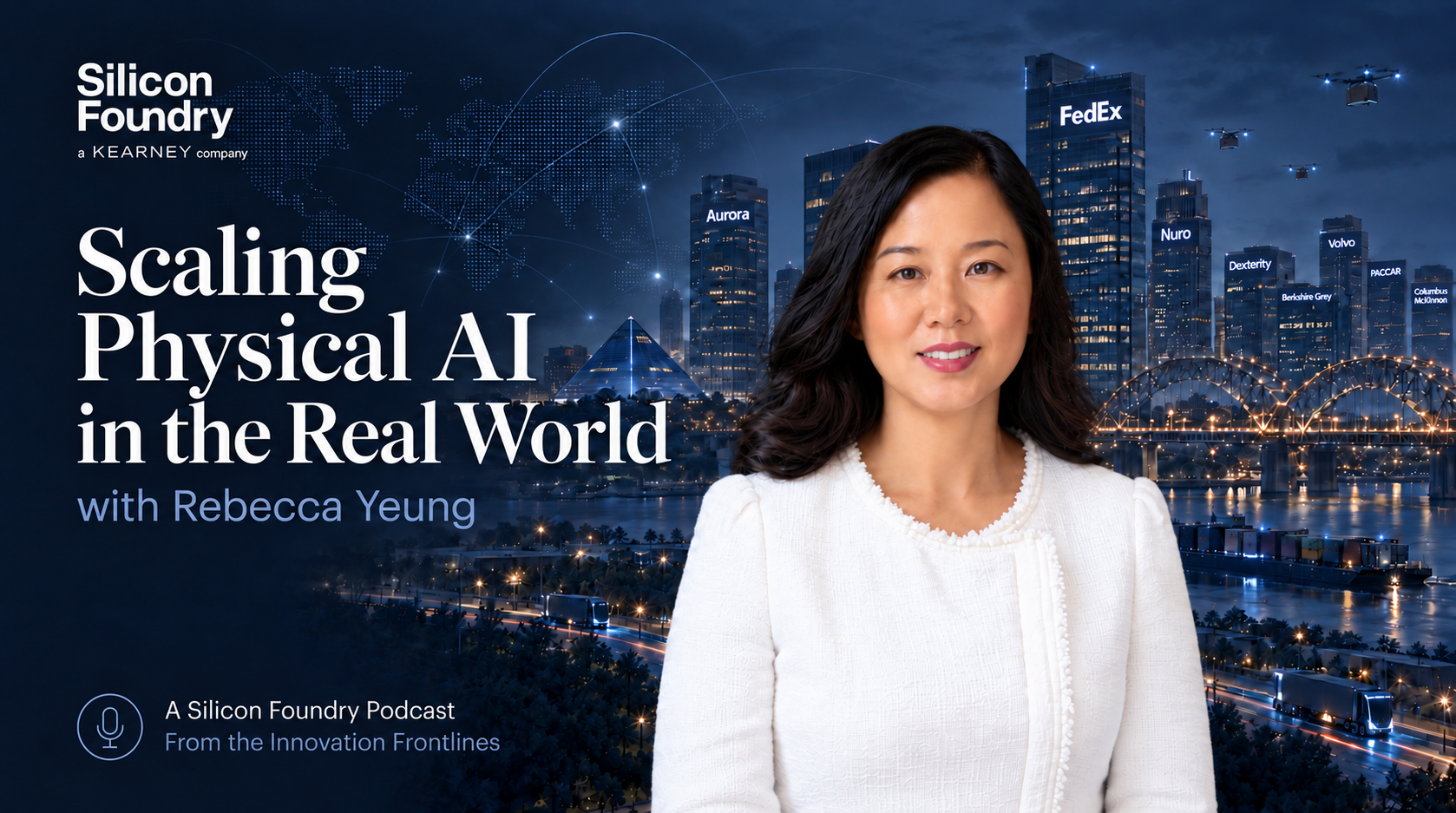
It’s super exciting to hear Raj talk about the AI’s transformation value, and I’m excited he mentioned three major physical AI initiatives that I initiated at FedEx. And the first one is Aurora. which is the collaboration to bring autonomous line haul technology and today it’s at 700,000 autonomous miles, which is huge. And the reason we went into this space is because of the driver shortage. If you look at the age of the highway drivers and for longer line haul, we see some potential future challenges. So that’s an area we doubled down early on and established partnership. Raj also talked about robotics trailer load, trailer loading and unloading with both Dexterity and Berkshire Gray. There’s a huge amount of operation automation already in place. Anything went into the sortation center when they hit the belt, it’s fully automated from end to end. The two only two touch points are input and output, which is the trailer has to be unloaded and put the packages on the belt and then trailer has to, once it’s sorted, the package has to be loaded.
Scaling from the lab to real operations
And that makes total sense. So, and just for context here, you’ve spent so many years leading innovation at FedEx and deploying robotics, autonomous vehicles, AI, and to your point, it’s 19 million packages per day with many, many, many complexities. What is the biggest misconception companies have about you know moving from like a cool demo to like and a full scale deployment at this scale?
Beyond the business case you’re solving starting with a problem worth solving for. The first challenge to tackle is actually the real world is very different than lab. Because you can have a perfect lab-proof like physical AI solutions. And once you get into the real world, the operations environment is very messy, for example, you have to handle to the lighting, which affect the sense sensor system, to the dust, to like some of those kind of temperatures. There’s a huge temperature rate range in the real world operations and the to how close they can operate around ah team members to the exception handling, the integration. And the moment you put it into the operations and it’s the first test, like does it work? I mean, how do you engage those frontline employees first? You can get feedback from them, you can get their excitement, make them feel comfortable. FedEx team members really love the robotics trailer loading onloading position because it’s very hard for humans to do. Like they welcome it. So for a company really to turn from just a one moment demo to the real scale operations, you have to go through all of this real-world test with real-world performance.
Designing startup partnerships for scale
Rebecca, it’s fascinating listening to you. You have such depth of experience, but you also have this macro view of where the world is going. Any boardroom or any management company obviously would benefit from you being in the room with them. But you work with startups as well, which is an amazing asset to startups. How you’re helping them bridge kind of startup lens to enterprise reality? What’s working, what’s not working.
So with Aurora and Neuro, the part I work with them is early on really focus on safety. I mean, we pick them because they have a safety culture. Their founders have amazing credentials, talent team, but we picked them because they focus a lot on safety versus some of those autonomous vehicle companies that made me a little bit uncomfortable trying to cut corners and be fast. And the value we bring to them also for startup is really the taking from airline kind of like experience is understanding the redundancy need early on and integration with vehicles. Because based on the industry knowledge, we know that airplanes can have an auto pallet, but it has secondary tertiary redundancy because you cannot allow any safety incident.
So for them, it’s not about their system, it’s like how you integrate with vehicles. So you have to have OEMs and you have to integrate with their cam, their redundant braking, steering, all of those systems. So that’s how we collaborate
And when we first announced Aurora, with a FedEx Aurora kind of partnership, we included PECA. That was the first industry technology and kind of OEM collaboration because you have to have all the pieces come together. So that’s how we help startups. And with Dexterity and also Berkshire Gray, when we work on the robotics trailer loading and unloading is to advise them, like early on, the integration is really key. It’s not just about your system. It’s end-to-end process and the system that have to work.
So the operations knowledge, like sharing the operations requirement with startups, really help startups design the solutions early on as feasible and designed for skill.
Hard lessons for startups and enterprises
So that’s a lot of practical, tactical advice that if you don’t get it right, obviously, there won’t be an opportunity to partner. We call this podcast hard lessons. Keeping the startup enterprise lens for a minute and then we can broaden it. What are the big mistakes you see being made?
THe first one I mentioned earlier is that they start with a technology, fascinated to see which problem I could solve for. They didn’t think about business. Second one was that they’re not sought for in picking the business partners that can help them scale versus like just team up with, like do too many pilots because you want to be very efficient in terms of what you’re working on and who you work with.
So, step one, match the solution to a need. Make sure you’re actually addressing a true need. Number two, make sure you’re dealing with the right stakeholders. And then probably most importantly, number three, adjust your timelines accordingly because inevitably the startup will be wanting to move much faster than the enterprise and time is money. And it’s okay.
Time is money. And also the first one startup needed to understand doing physical AI requires a lot of capital investment. If they burn capital too fast, they will be out of business before they can even advance further.
Is it fair to say that enterprises should try to aggressively access the corporate balance sheets to help address some of the capital needs? Because sometimes startups are a little bit shy. They’re like, I’ve got to go raise more venture capital to go do this project with XYZ automotive company. How receptive are enterprises to saying, look, we have the tech, we have the patience, but we need your capital. So put your money where your mouth is, enterprise.
I think it all depends on the enterprise and the risk level and their mindset. Innovative companies that want to get ahead and have a good balance sheet, they’re more willing. And of course, if they invest, they would be like asking certain conditions, like I would have equity stake and I need a guarantee of certain production and all of those kinds of conditions. So innovative companies that have good cash flow, good balance, will be willing to do that. But you also have enterprise or kind of businesses in very low margin business, and they are more concerned about spending the money, and they would rather just be a fast follower, and just like once the solution is developed, they do.
Investing at the right moment
We certainly see that. Some are more focused on innovation theater, but to your point, you want to make sure that you know whoever you partner with have their money and business priorities where you know the efforts are being allocated.
Back to the hard lessons, what are your biggest lessons learned? Like scar tissues, failed experiments that you’ve had that really kind of shaped the way you lead and, you know, just drive innovation?
The biggest lesson I learned in my career is that it’s important to actually invest at the right inflection point of the technology. And sometimes the business concept could make a lot of sense, but if you invest too early, the technology may not be ready or it could be very expensive. So I want to give you one small experiment we did a few years ago. We were like, okay, FedEx has lots of of vehicles, can we do vehicle sensor kind of like ah monetization, which sounds like a great idea because you can have cameras, you use AI to process information and then you can find foliage or you can find a pothole and all of those areas. We didn’t spend lots of money or do too long because we immediately recognized the technology was not ready at that point, like the image captured by the sensor was not clear enough and then the AI to process it wasn’t advanced enough. So, I always believe in innovation, you fail fast, you fail early in order to succeed like much bigger. So the kind of lesson learned is capturing the right moment. And recently I saw, I think, Alphabet actually announced their combination Waze and Waymo started to capture the road conditions. And they can triangulate the specific location. They are sending pothole information to the city to properly prepare. I was like, oh, that was the kind of experiment we did a year ago. It wasn’t just ahead of its time, but a core lesson is to invest the right amount of resources at the right inflection point, is super critical.
What Rules? Think Differently About Success and Cultivate a Happy Life
Yeah, no, totally, timing plays a big role. It could be a great idea, a great market opportunity, and if the timing’s off, which it seems like when you were piloting it might have been a little bit early, but like really good merits, um you know it’s it doesn’t take off. Just to finish off here, you wrote an incredible book, What Rules? Think Differently About Success and Cultivate a Happy Life. Tell us, you know what was the catalyst for you to put pen to paper and sort of develop that whole theory?
The main thing is to spread what I learned to share some of those lessons with readers that feel comfortable to challenge the status quo to actually find their own unique path to be successful as well as be happy in life. And so a little bit of background. I grew up on the countryside without running water or electricity. Eventually became the top leader within a Fortune 50 business, leading autonomous robotics, physical AI technology. Like In my life, I had a lot of unconventional paths, I was dyslexic, undiagnosed, but I graduated from a top college with an English major as a degree because listening like based on my auditorium, like skills.
I went into a major company, but it wasn’t interesting in a traditional role. eventually paved, carved out a unique path on innovation and the rise up to the very top. And so I want people to feel comfortable that in life, there are a lot of conventional rules and expectations and some of them mean well, but may not be the path you take.
So I wrote all the different rules to challenge conventional thinking. And one example I use is the weakness rule. Because in our life, how many times feels that you have to work on your weakness and mean we immediately jump to say, spend all my energy addressing my weakness. And so if I draw a line weakness tends to be below the average, right? That’s why it’s your weakness. So you can spend your life long, you improve all the weakness areas you have, then you become a nice average. Okay, I have to address my weakness, but I spend more energy, amplify my strength, so I move the line up, then you differentiate yourself. So I write those to say, sometimes maybe a little bit I’m always an out-the-box thinker, was like, maybe ah you challenge the conventional rules, you might be more successful and be happier in your life.
Oh, my God. I love what you say. Rebecca, this was amazing.
That’s it for this episode of Hard Lessons. If you enjoyed the conversation, follow the show on Spotify or Apple Podcasts, and visit sifoundry.com for more on corporate innovation and emerging technology. Hard Lessons is brought to you by Silicon Foundry, trusted advisors to Fortune 500 companies.