Podcast: Play in new window | Download
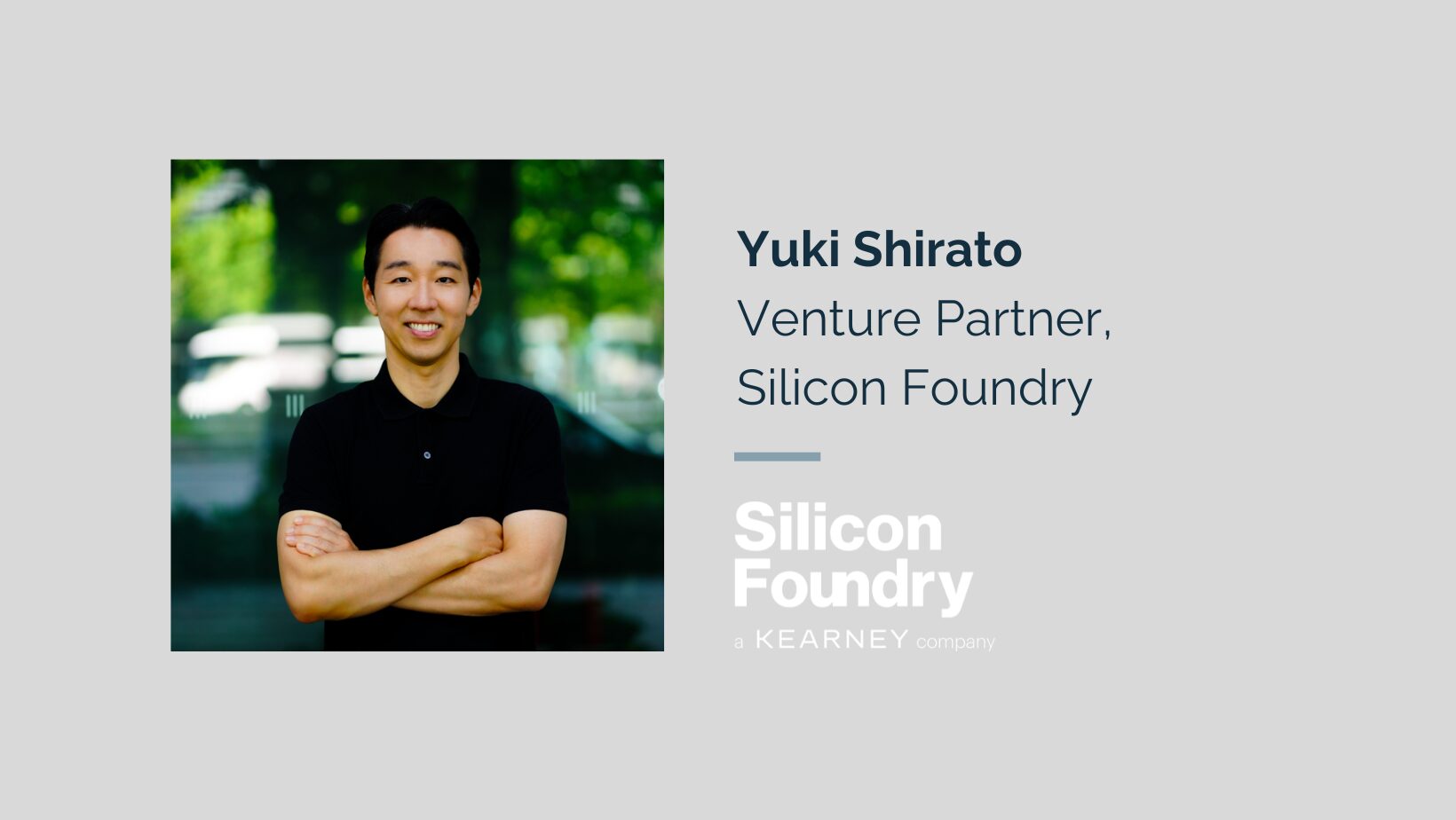
We’re pleased to welcome our newest Venture Partner, Yuki Shirato, Managing Director of Techstars Japan. A seasoned investor, serial entrepreneur, and attorney with more than 25 years of experience across global markets, Yuki has backed over 50 startups as an angel investor and founded Yakumi, an international angel network connecting investors across Japan, the US, Europe, Asia, and the Middle East. He also serves as Senior Advisor at Pangaea Ventures.
At Silicon Foundry, Yuki works alongside corporate leaders and venture investors to strengthen cross-border innovation strategies, unlock global startup ecosystems, and translate emerging technologies into durable business growth.
We recently sat down with Yuki to learn more about his past experiences and current work today.
Press play to listen to this conversation
Across your work in law, startups, and investing, you’ve operated at the intersection of strategy and execution. What has been the consistent thread in how you approach that work?
The throughline, for me, is the work of translating complexity into something executable. Whether I was navigating the legal intricacies of cross-border M&As, scaling an early-stage startup, or sitting on the investor side of the table, my focus has always been on translating high-level vision into operational structures that actually work in practice.
From the outside, my path may look eclectic and even a bit random: I started my career as a researcher and lobbyist, then moved into management consultancy, then corporate law, and finally became a founder and an investor. However, each move was an intentional step closer to the point where vision meets execution.
The roles I’ve taken were less a function of linear progression than a deliberate movement toward where I believe the future is being built: at the seams across disciplines and geographies. What ties it all together is a conviction that the most interesting problems live in those seams, and that someone needs to be fluent enough in each language to hold them together.
How has your perspective as a serial entrepreneur shaped the way you evaluate founders?
Being a founder myself has taught me that a pitch is just a hypothesis at a particular moment in time. The deck you write in January can mean something completely different by February. This is not because the founder changed, but because the world does. Imagine pitching a portable device the week before the Walkman or iPhone launched, or an AI startup the day before ChatGPT shipped. Overnight, some ideas become obsolete, and others suddenly have a completely new meaning. Founders don’t get to choose when those moments arrive; they only get to choose how they respond. That’s why what I’ve learned to look for is the founder’s underlying operating system.
When I evaluate early-stage founders, I prioritize resiliency and persistence without losing drive or momentum. Resilience without momentum becomes stoicism; momentum without resilience burns out. The founders who compound are the ones who can absorb hard feedback, update quickly, and still walk into the next meeting with conviction. Having lived through many of my own pivots and near-misses, I also have a high tolerance for incompleteness and imperfection. I care less about the story’s polish and more about how the founder thinks and demonstrates the vision.
In your opinion, what makes an accelerator program genuinely catalytic versus simply supportive?
In my mind, being supportive means providing a network and resources, which is, of course, incredibly foundational. A catalyst instead provides velocity, momentum, and compresses years of learning and struggling into only months. The difference usually comes down to two variables: the density and quality of the network the founder is plugged into, and the pressure the program is willing to apply. Programs that simply “support” tend to be comfortable; catalytic programs are productively uncomfortable.
At Techstars Tokyo, my method is more Socratic than prescriptive. I try to help founders realize for themselves what needs to be done, rather than handing them a playbook. When a founder concludes their own reasoning, with mentors as a sounding board, that conviction sticks and scales. When you tell them what to do, you’ve created a dependency. Catalytic programs build founders who can think; supportive programs build founders who can follow instructions.
What inspired you to found Yakumi, and what gap were you aiming to solve?
When I came back to Japan from North America, I saw a massive “trust asymmetry” in early-stage investing. Great deals in Japan couldn’t reach the right global angel investors. At the same time, operators in the US, Europe, and Asia wanted exposure in Japan but had no trusted entry point. The angel ecosystem is fundamentally local and deeply relationship-driven, especially at the earliest stages — introductions matter more than pitch decks, and the unspoken context around a deal is often as important as the financials.
But those relationships don’t scale easily across borders. The result was that capital and talent were stuck on opposite sides of a glass wall, watching each other but unable to transact with confidence. Yakumi was built to be that connective tissue: a structure where trust could travel across time zones, where the cultural and informational gaps that normally kill cross-border deals could be absorbed by people who had operated on both sides.
How can corporations structure partnerships for strategic advantage rather than incremental pilots?
Large corporations have to move from a procurement mindset (in Japanese, shitauke kankei) to a partnership mindset, and that shift is harder than it sounds because it requires changing who owns the relationship internally and why. A procurement mindset asks, “What can this startup deliver, on what timeline, at what price?” A partnership mindset asks, “What can we build together that will be mutually beneficial?” Real strategic advantage requires the corporation to put something genuinely at risk, whether that’s customers, capital, or internal resources. Without that commitment, pilots tend to stay confined to innovation labs and never reach the core business.
The advantage emerges when the startup’s agility, new technology, and out-of-the-box perspective are paired with the corporation’s scale, distribution, and regulatory standing. I’ve seen similar mistakes in the post-merger integration where no new value is created due to a lack of a partnership mindset.
How has Japan’s startup ecosystem evolved over the past five years?
Japan has moved meaningfully from an insular system to a potential global contender, though the shift is still in progress. Until five years ago, the dominant model was domestic-first: build for the Japanese market, IPO on the TSE Growth Market (formerly Mothers) relatively early at valuations of $50–100 million, and treat international expansion, which for most meant only the U.S., as a later-stage goal.
Today, the picture looks different. Foreign VCs are actively scouting and writing checks in Japan, and a new generation of founders from Japan – whether Japanese or foreign – aims to go global: designing their products and hiring strategies for global scale, and bringing international investors onto the cap table from day one.
Just as importantly, we’re seeing the emergence of a second-generation founder class: people who built their first companies, experienced exits or failures, and are now coming back to build again with far more sophistication. The data is consistent globally: repeat founders have meaningfully higher success rates, and Japan is finally accumulating that compounding base of experience. The ecosystem isn’t fully mature yet, but the trajectory is clear, and I hope the next five years will look very different from the last five.
Looking ahead, how will your global experience translate into tangible opportunities for Silicon Foundry?
What I bring is a proprietary bridge, not just a Rolodex. Silicon Foundry’s core strength is helping enterprises navigate innovation with a level of confidence they couldn’t generate internally. That confidence depends on the quality of pattern recognition behind every recommendation. I can contribute a set of relationships and reference patterns that don’t exist within any single geography: how a Japanese conglomerate actually evaluates a Silicon Valley partnership, how a North American operator reads the Japanese market, and where the predictable friction points are when those two worlds try to transact.
For Silicon Foundry’s members, that translates into shorter cycles between interest and action, better-qualified introductions, and partnerships that survive the handoff from the innovation team to the operating business. To me, the goal is not to give members access to more startups without context, but to help them transform their ambitions into actual global revenue by working with, acquiring, or co-developing with startups.