Podcast: Play in new window | Download
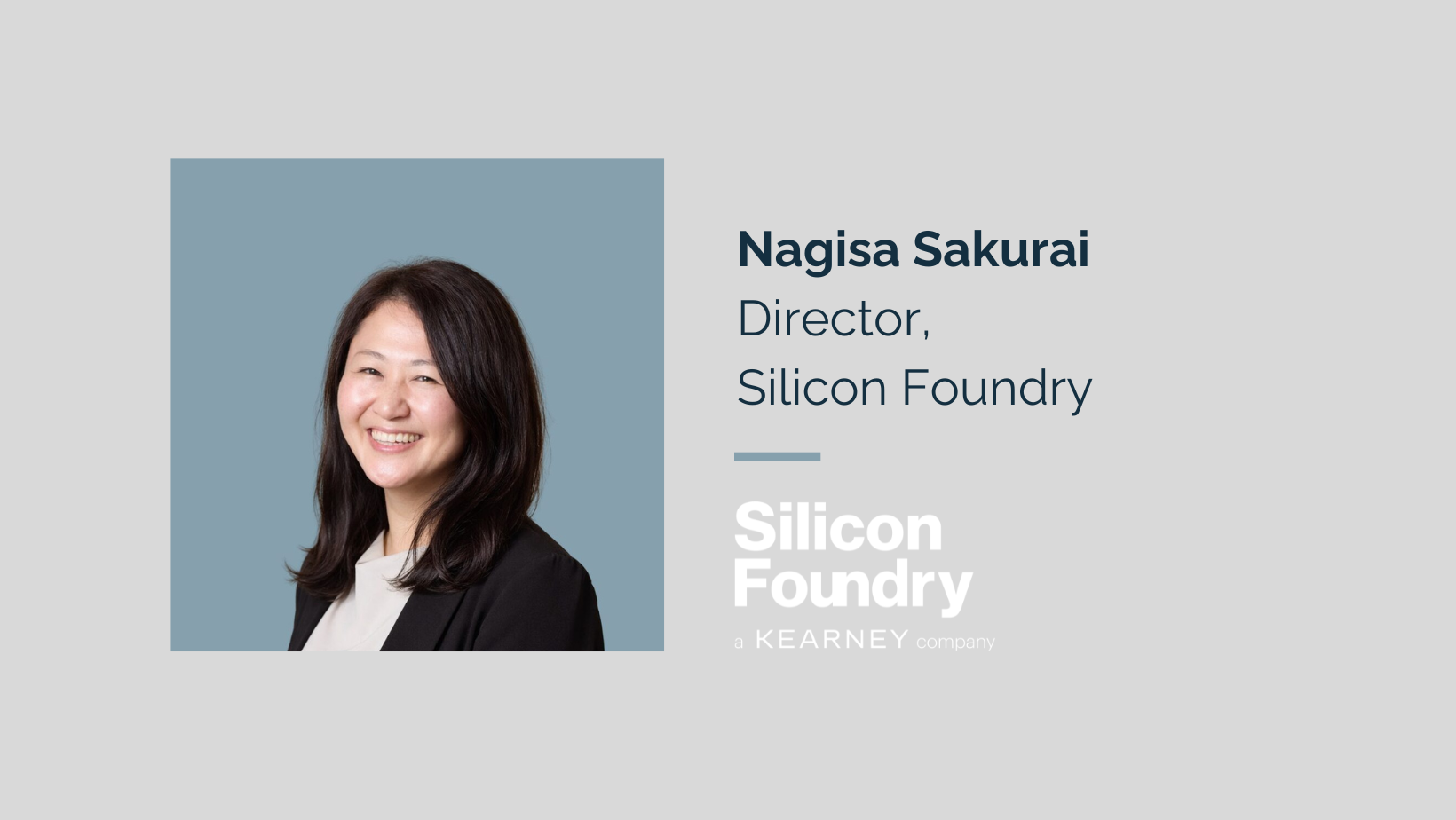
We’re pleased to welcome Nagisa Sakurai, who is joining as a Director and as Silicon Foundry’s first Asia-based team member. With a background spanning life sciences, regenerative medicine, corporate venture capital, and corporate innovation, Nagisa brings a multidisciplinary perspective to emerging technologies and global innovation ecosystems. Her experience includes roles across research institutions and industry organizations, including City of Hope Cancer Center, Washington University in St. Louis, and Astellas Pharma.
At Silicon Foundry, Nagisa will help strengthen collaboration between Japanese and global innovation ecosystems, working with corporates, startups, and investors to navigate emerging technologies and unlock cross-border opportunities.
We recently sat down with Nagisa to learn more about her career journey, Japan’s evolving startup ecosystem, and the future of innovation across Asia and beyond.
Press play to listen to this conversation
To start from the very beginning, what would you say first sparked your interest in innovation, venture, or working at the intersection of technology and business?
What first got me interested in innovation and the intersection of technology and business was realizing that even great technologies do not automatically create impact unless someone can connect the science and business. During my time working in life sciences, a pivotal moment was when I was evaluating a delivery technology related to cell therapy. Since I had spent almost ten years in that area, I immediately felt the technology had strong potential to become important in the future of cell therapy. However, people on the business side could not clearly see how the technology would create business value. That experience surprised me because we were looking at the same technology inside the same company, but seeing completely different things.
Throughout my career, I’ve found that there is a limited number of people who can work between the intersection of science and business, especially when I worked in CVC and corporate innovation. Venture ecosystems often amplify certain technology trends, and startups move very quickly toward those trends, but not corporates. They also have to think about existing businesses, internal priorities, timing, and organizational structure. So I recognized that if we want innovation ecosystems to work well, we need people who can understand and translate between those different worlds.
That is still the part of innovation I find the most interesting today.
As Silicon Foundry’s first Asia-based team member, what excites you most about this role, and what opportunities do you hope to unlock?
I’m excited to help connect Japanese and Asian companies more closely with the global innovation ecosystem, and to bring more visibility to the strengths and perspectives coming from this region.
Japanese companies have incredibly strong technical capabilities and deep industry expertise, but there is still a lot of opportunity to strengthen collaboration with global startups and emerging technology ecosystems. At the same time, many startups outside Japan do not fully understand the Japanese market, how Japanese companies make decisions, or what kinds of problems enterprises are actually trying to solve. Because I have worked across life sciences and corporate innovation, I’ve seen how different players operate with very different timelines, incentives, and expectations.
Your background spans life sciences as well as venture and corporate innovation. How does that shape the way you evaluate new technologies or opportunities? Does that experience give you a different lens when assessing what will scale or create real impact?
My background helps me evaluate both technologies from a technical perspective and how innovation gets adopted and scaled in the real world. Through my experience in life sciences, I saw how long and complex the path can be from breakthrough research to real societal impact.
Through my experience in venture ecosystems, I recognized how certain technology trends can attract attention and capital very quickly. But corporates do not always move on the same timeline due to their broad priorities. So when I evaluate new technologies or opportunities, I tend to look not only at whether the technology itself is impressive, but also who will adopt it, whether organizations are ready for it, whether the market timing is right, and how it’ll fit into existing industry structures. Ultimately, I believe technologies scale when these various factors come together at the same time.
From your perspective, where do you think Japan is making the most progress in expanding its tech ecosystem, and where is there still room for improvement?
The ecosystem has changed significantly over the past five to ten years, but the progress really depends on the sector. From my perspective, one of Japan’s biggest strengths is in deep tech and industrial technology, such as robotics, advanced manufacturing, or climate-related technologies. Japan has deep capabilities in manufacturing, precision engineering, and long-term R&D, and those strengths are becoming more important in the AI era.
For a long time, many of those technologies remained within large corporations or academia, but now we are seeing more university spinouts, carve-outs, CVC activity, and government support that are helping those innovations move into the startup ecosystem. That is a very meaningful shift.
At the same time, there are still areas where Japan faces structural challenges. One is global product thinking, because many startups are still primarily optimized for the domestic market. Another is long-term risk capital and talent mobility, where in deep tech and healthcare, companies often require patient capital and experienced operators over a long period of time.
Overall, Japan does not need to become “another Silicon Valley,” but has a unique opportunity to lead in areas like industrial AI, robotics, automation, and human-machine systems.
How would you describe the Japanese tech and startup ecosystem today to someone based in the U.S.? What do you think people outside Japan often misunderstand?
When describing the ecosystem, I usually start by saying that Japan has extremely strong technical and scientific capabilities. Especially in areas like deep tech and healthcare, there are many world-class technologies coming from universities, research institutions, and large corporations.
At the same time, Japan’s historical challenge has been the commercialization of the technology. There has been a shortage of experienced operators who can connect R&D with market needs, fewer management teams experienced in scaling deep tech companies, and less infrastructure supporting commercialization. However, we are gradually seeing this change, and Japan is now actively building the next stage of its innovation ecosystem.
Looking ahead, what trends or shifts in Japan’s innovation ecosystem are you personally most excited about right now?
I am especially excited about the growing focus on translating deep tech and AI into real-world industries, as mentioned above. Further, I am excited about the emergence of more regional innovation ecosystems across Japan, but beyond Tokyo. Tokyo will likely continue to be the center of the startup ecosystem, especially with increasing government support and global capital participation. But at the same time, regions like Kansai, Kyushu, and Fukuoka are building ecosystems based on their own industrial and academic strengths.
Although Japan is not as geographically large as the U.S., regional specialization could become an important strength. Ultimately, the key will be continuing to connect people of different expertise more effectively. This network infrastructure will build the ecosystem for people who can bring those technologies into the world.
Outside of work, what’s something people might be surprised to learn about you?
I really enjoy hiking and backpacking, especially multi-day trips where I carry everything with me and camp in the mountains. When I was living in the U.S., I climbed Mt. Whitney, and I really loved that experience.
One reason I enjoy hiking is that it is not about competing with other people. Even if you move slowly, you can reach the summit. Of course, during the hike, there are always difficult moments, but when you finally reach the top, the view is so beautiful that you almost forget all the struggle along the way. In some ways, I feel there is a similarity between innovation and career growth as well. Sometimes meaningful progress takes a long time, but continuing steadily can eventually lead you somewhere very rewarding.