Podcast: Play in new window | Download
Introduction
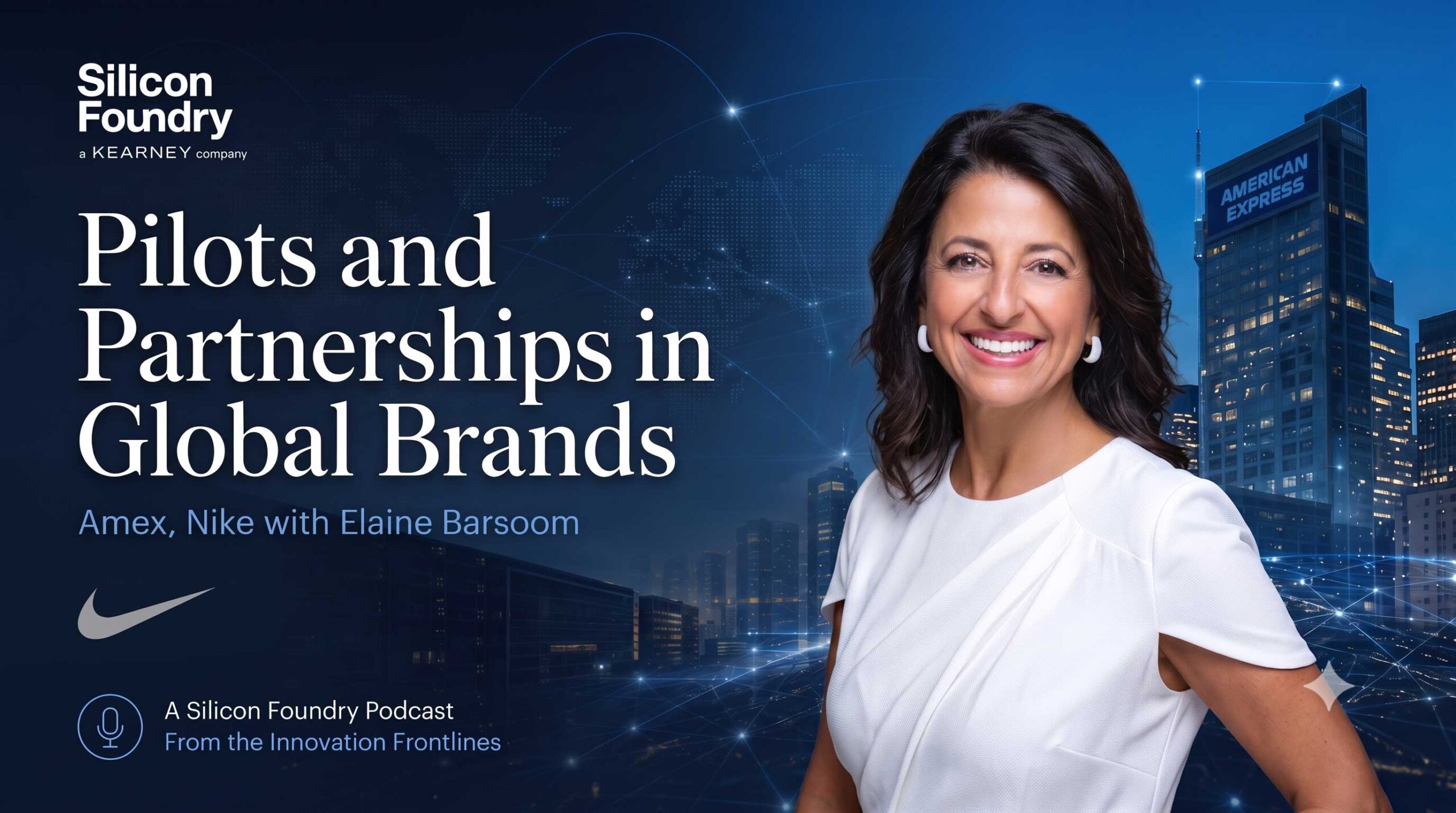
Elaine, welcome. Welcome to Hard Lessons. We’re really excited to have you here. You’ve had a front row seat to corporate innovation at some of the biggest and most complex organizations out there. Thinking about JP Morgan, American Express, Nike. And then on the high growth startup side, you worked at Airbnb and Zeal. So you’ve truly seen it from every angle. Across your career, you’ve been involved in over a billion dollars in joint ventures and partnerships and strategic deals. So this really isn’t theoretical for you. You have legit street cred. And you’ve been in the room making these decisions happen, which is pretty impressive. At Nike, you were right at the center of their big push into emerging tech. You evaluated over 300 startups. and helped them shape how they think about partnerships and innovation, and later stood up the AI center of excellence to figure out where generative AI could drive real business value. And earlier at Amex, you helped build and scale a joint venture that grew to over $200 million, which is really impressive, no small feat, at a company like that. So you really understand what it takes not just to talk about innovation, but to actually make it work inside large organizations where things are messy and don’t move very fast. We’re really excited to get into it with you. The wins, the challenges, the hard lessons learned along the way.
Early Influences and Systems Thinking
Let’s start from the beginning and take us back. Where did you grow up and what were you like as a kid?
Oh, thanks, Tanya. Great to be here. I was a daughter of Egyptian immigrants. My father was a corporate banker turned entrepreneur multiple times. I’ve watched him build multiple businesses. I watched him fail at multiple businesses. And that really kind of showed me sheer determination and a bit of pattern recognition. That coupled with, I would say, my high school. IPL class was Institute for Political Legal Education, which really propelled me to pursue a degree in political science and international affairs. And so all of that pattern recognition, systems thinking really got me to where I am today.
Getting into Corporate Innovation
Which probably is what partly contributed to you going into corporate innovation. So how did you make your way into that?
Yeah, absolutely. So I was graduating from Columbia School of International Public Affairs, and I really hadn’t been in the private sector at all. I was working at the UN and the World Bank and doing stints abroad in Egypt. And I had a great mentor and teacher mentored me to go into the private sector. big change and saw me as I was really passionate about change and systems, said, go into the private sector. That’s where you can make the largest change from the inside out. So that’s what I did. So my first job was PricewaterhouseCoopers in a more consulting role, actually, working in emerging markets.
Inside Nike’s Innovation Mandate
All right. Well, maybe we could get into, I mean, there’s so many things to get into, but maybe we can start with your time at Nike. So you had a really interesting run, four years, and you did all kinds of corporate innovation activities. What was your mandate there and what was your focus?
Oh, yeah. I was brought in during COVID. And at that point, John Donahoe, who was the CEO at that time, was making a massive strategic shift towards consumer direct. So Nike traditionally sold through wholesale partners. And so we wanted to use all of the data to go directly to consumers. And Nike didn’t really have. an internal organization that was set up for that. So we were brought in really to look and bringing in an outside in viewpoint of where all these external technologies and how can it actually accelerate some of the work that we were doing internally across the businesses. So across marketing, across e-commerce, setting up our data infrastructure. And so we really looked holistically across the enterprise as like a centralized innovation team.And when you arrived at the doorstep of Nike, was there already an innovation team? Because I seem to remember over the last 15 years, there was Nike Labs, there were accelerator programs. Did you inherit any of that infrastructure and or kill it, or it had already been killed?
There were still business innovation teams. Well, we worked from the technology side, and so there wasn’t a real technology innovation team that was focused on emerging technology startups accelerators. That had never existed. prior to this.
I think Tanya and Neil and Foundry team have heard this over and over and over again. We want to go direct. We want to have the relationship with our consumer as opposed to being being holden to the intermediaries, the middlemen, Apple,Meta, Google. What grade would you give the industry on being able to build that direct relationship and is it realistic? And then what happens in an agentic world where all of a sudden our favorite intermediaries are inserting themselves as the agent of record and now they’re the intermediary between The consumer and the brand wants more and you no longer have websites, you no longer have advertising, you no longer have all these things that were the tools that you thought you had to get to your consumer. And now all of a sudden, those are all in question.
So I’m going to reframe the question a bit. Traditionally, when you’ve got a huge corporate organization like Nike that has traditionally owned partnerships with wholesale partners, it’s very difficult to do the migration to consumer. I would say that Nike first did that really well during COVID. We certainly had the advantage of COVID and going to e-commerce with retail shutting down and foot traffic. So they were definitely, we were accelerating business. But once COVID ended, it became much more difficult. You’re just competing for noise. And when you don’t have the infrastructure, when consumers are used to going into retail store and shopping and… very hard to change behavior like that. They’re used to shopping at Meta in a certain way. They’re used to interacting with Instagram in a certain way. They’re used to interacting with Nike at the store. Didn’t we have a return to retail, though, after COVID? And that was a good thing.
It was a good thing. It might have been…
Not the Nike stores. So they’re going to like Foot Locker.They’re going to other retailers. Okay.
Nike had sold out at a lot of wholesale partners. So it became very challenging. And so that’s where operational efficiency became more paramount.
AI, Retail, and the Fight for the Customer
You’ve been really vocal about AI. You’ve been talking about the impact of AI, in particular around replacing or augmenting humans, which I’m sure we’ll get to. But when you think about it in the context of agentex commerce, are brands in for another round of hurt? by being disintermediated. In other words, they’re not the agent of record. They’re not the one making recommendations to the consumer. Once again, they are fighting the noise, as you said.
They’re fighting for share.
And haven’t they lost or won’t they potentially lose a lot of the levers and buttons and dials that they’ve relied on so much? keywords and search placement and frankly, advertising, doesn’t that all kind of maybe go away or be completely turned on its head?
Well, let me take an example for a minute because I’m not so sure that it’s going to replace the way consumers shop immediately. And retail traditionally has always been late to the game. I was talking to someone that’s working with Lowe’s and they completely changed. Their whole approach to retail, how we sell, how do customers shop, and how do employees interact with one another. And they developed what they called Milo, all based on the infrastructure of how do we incorporate this across our whole ecosystem. And they did an incredible job of being able to imagine how the consumer shops. They look at the, you take a picture of your kitchen, upload it, and you can actually. purchase the products right then and there. And they saw a conversion rate, he was telling me, of 22% of some sorts. So they were able to incorporate AI and all of these tools into the consumer experience. So it’s a matter of, can we evolve to follow how the customer is shopping, how the customer is behaving now?
How Nike Backed Open Innovation
I want to get back to the open innovation kind of function. You were brought on to really lead. Nike’s open innovation initiatives. And initially that included a venture arm and big goals. Talk through what was happening internally that made this mandate a priority. Who was championing it?
There was a whole new team at the time. There was a new CTO. And in order to accelerate that vision, John Donahoe’s vision, we thought we would go out and make some acquisitions drive some investments. Nike’s much more, they’ve always been much more cautious on the investment and the M&A side. So we really just focused on the partnerships and the scaling of these startups and the pilots. That’s where we ended up focusing on.
What Founders Get Wrong About Pilots
Talk about pilots. I mean, I can’t tell you the number of times a founder in a board meeting, you know, shows up. I’m so excited. I got a pilot with Nike. And then we kind of all roll our eyes because we’re like, oh, shit.
The success rate, yeah.
Yeah, the success rate is so low and we’re just kind of like, uh. And now some more savvy founders are really pushing hard to skip pilot, right? They’re just saying, hey, look, the other guys use my product. It works. And to talk a little bit about to a founder. So you’re speaking to a founder, giving them sage advice, how to navigate the both opportunity and the trap of a pilot.
Yeah, we had a framework internally. And so there were multiple stage gates before we would even scale a pilot. So sometimes a pilot, we would walk into a pilot, knowing that we just we wanted to learn and that necessarily the organization wasn’t ready for that. So pilot doesn’t necessarily translate it to scale.
Did you ever have a super high pilot stakes that just really didn’t go the way that you wanted it to?
Many. I would say that one particular high pilot stake is what we were looking for. It was an Israeli tech company. It was a MarTech company that had incredible potential to actually accelerate our e-commerce conversion. And we tested it in a small pilot. really effective, but we were locked into vendor relationships. Nobody was really willing to put in the resources to change, to adopt it. There were other competing priorities, so we never really scaled it.
For the pilot paradigm, you’ve got a business unit sponsor. Let’s say you’re the champion, you’re the shepherd, to use your term, and the innovation term. Going back to that, some of them were learning expeditions, and that was the main driver. But for those that were beyond that, How often would you clearly define this is what scale will look like? Hey, entrepreneur, if this pilot is successful by the KPIs that we collectively establish, you’ve already got in your mind or you’re communicating to the entrepreneur, this is how we’ll scale beyond. So successful pilot leads to big opportunity for you. Or would you keep that in your back pocket, only get to the KPIs, and then, hey, we’ll talk about it then, assuming we achieve those milestones.
It was more the latter. For sure. The KPIs can be met, Neil, but I think it goes back to organizational readiness and the capabilities. So what really is a good measure of a pilot, and also just from a legal perspective, running a pilot in a sandbox environment versus running it to scale are very different. There’s a lot of teams that are involved, not just the teams that were involved in the pilot when you go to scale. And so sometimes, most of the time, you don’t have all of those teams involved in the pilot until you can actually prove success of what this capability can provide at scale.
The Pilots Younger Sibling: Design Partnerships
I want to talk about the pilot’s younger sibling, the design partnership. This idea that, hey, we’re a startup, we’ve got this great concept, but boy, we need to learn about the industry. Did you do any design partnerships in your career, either Nike or elsewhere? And do those work or are they more kind of… you know, overly optimistic thinking from a founder?
They’re difficult. There are certain standards. I mean, we definitely did do that because we work with universities, we work with Google on research, and that really gave us an ability to commercialize something new. One example was really early days with NVIDIA. We were just looking at how to accelerate our design to production. And so we really worked with them on how to incorporate that into our production process, testing it. And so that was more of a design partnership.
You got to go in eyes wide open on a design partnership. Your KPI is learning. And by me asking you if it’s successful, the answer is yes, right? Because we all learned a lot. Now, did it become a commercial relationship? No, but honestly, that wasn’t the goal. And if you go in with the idea that a design partnership is going to flourish into some massive contract, then… you’re misguided from the beginning. Yeah, absolutely. And for a huge company like NVIDIA, I mean, they understand that. But for a small startup founder where you only have a certain amount of hours per week and you got to focus on the biggest ROI, then that’s a different conversation to have.
Avoiding Innovation Theater in the AI Era
So speaking about pilots and evaluating startups and advice for founders, you actually, within Nike, set up the Center of Excellence, where you evaluated all emerging tech and AI. What was the mandate internally? Whose idea was it to stand this up? Bring us back to that moment.
So at this point, it was a few years into my tenure when AI really, or generative AI really started to… make a headline. And at that point, we had evaluated over 300 startups, were running pilots. The CEO’s mandate was really to look across the enterprise and evaluate use cases where AI and generative AI can really drive operational efficiency, cost reduction, simply. And actually test with, you know, bring the startups. It was so new and nascent as with every other organization. We wanted to bring in the experts from the outside in order to evaluate that. So we set up a center of excellence, a small tiger team to both put together the frameworks and then actually run some pilots with some AI capabilities that were out there. The first, I would say, was software engineering, GitHub Copilot. It was the most mature in terms of the capabilities that were out there. And we were able to test pretty quickly with a hackathon and see the difference between productivity before between baseline and with GitHub Copilot.
And, you know, the center of excellence mean, I’m assuming everything was sort of centralized. We see this in like a bunch of different corporates. Some folks have decentralized where all the innovation is coming in through the different BUs, business units. Others are centralized. What was the thinking there? Why that versus, you know, the alternative?
Well, I think it’s more hybrid. I would say that. You want to share the learning and the frameworks with a centralized function, but we actually don’t own all of it. When it scales, it scales to business teams and stuff. So it’s decentralized innovation across the organization. And with emerging technologies, especially with AI, where there’s so many unknowns and you’re working with senior leadership, you wanted to make sure that you were looking at it from a top down, from a risk perspective, from a legal perspective, from a… perspective before we started decentralizing. Eventually, that changed over time and more of the business units were allowed to experiment.
I think it’s a really good point as you emphasize hybrid because I think we’ve seen that in a lot of our work with corporates. It reminds me of a large cosmetics company. And Tanya, as you mentioned, different business units are essentially different brands. But as we worked with them, they had seven different brands all testing out virtual try-on, AI try-on. And so you have these duplicative efforts. Now, the reality is it would centralize the new technology priorities, and then they will federate out to the different brands. And so you kind of have the best of both worlds having a hybrid model.
I mean, you don’t want three different teams negotiating with the same vendor. It happens very often, more than you know. I’ll have a team partnership and all of a sudden they’re going out to the marketing team and you don’t want 10 different experiments that will end up in, you know, what I call innovation theater and AI swamp.
Yeah, I was gonna say, it feels like culture is a big part of this as well, right?
Culture for sure. And also the need to innovate, you know. So rubber soles and leather tops come in different colors, but they’re still shoes with laces versus when you look at the pace of innovation of a software company or a tech company, they’ve got to innovate every day.
Exactly. And so perhaps there’s something there as well that the rate of innovation might require more external efforts. I don’t know.
I mean, that might be a good parlay of moving from footwear to financial services.
Well done, Neil. Well done.
Amex, Montprivé, and Building a Joint Venture
Thank you. This is my job. But, you know, Amex, right? Amex, in many ways, you say it’s a tech company, right? And tech is a big differentiator. You were there for seven years. You were a boomerang. You were part of the corporate innovation team.
A bit different. And everything’s built on data, infrastructure, consumer spending. And so it had its own challenges. But from that perspective. Yeah, Amex was super innovative from the digital perspective, a very digital first company. How about its willingness to pilot quickly with startups and if it goes well, adopt their solutions? Because the competitive edge in financial services, it’s always been an early adopter of new tech, barring it’s got its own regulations and limitations, but it’s either more of a fast mover than retailers have been historically or brands.
The premise of Amex is a partnership organization, partnership with credit cards, partnership with banks, partnerships across the organization. So different culture internally. I mean, when I was brought back, it was really, we know the data. We believe that e-commerce is at its high and flash sale. And so let’s look at potentially either building a company within a company or doing a joint venture, which led to the Montprevay joint venture. And so that was exciting because we understood the consumer behavior. We knew that this was successful in Europe. It was a $2 billion joint venture at the time. Guilt was making its heyday as well as Rulala. So could we replicate that model with American Express and with a strong marketing organization and scale that?
So bring us through that. What was the moment you started? How did you scale? At what point did you say, oh, this is really, really working or not working? And what are the learnings? Well, it was complex because Amex had never done a JV of that with their name on it, Bon Preve with American Express. So once we actually signed the deal, it was speed to market. We thought that we could just take a business model that existed in Europe and that worked to the U.S. Turns out you can’t just take a company. And apply it to the U.S. It was a different commercial culture, more sales driven, different brand relationships, different consumer behaviors. It took some time. It took months before we could actually get the model right for the U.S. And what was giving the brand recognition was the American Express name. And so in order to do that, the JV was just appropriate as well as. utilizing economies of scale, utilizing all of Amex’s incredible assets, marketing, resources, data. And so when you brought a joint venture, we were bringing all of the digital assets and Montprevay was bringing all of the brand and the business model assets. We eventually scaled it. It was actually fast to $200 million over 18, 24 months. So it was quite successful as we scaled it and as we got the model right in the U.S.
And how did it play out?
This was just one of those unique examples. We had the backing of the executive teams. We had the assets that we were applying from a marketing perspective, from the data perspective, but yet operated as a different company. So you certainly had the internal tension, innovation tension, as this new startup that existed. But with executive sponsorship, we were able to scale it and get the resources needed to do that.
How Innovation Looks Different at Nike and Amex
We talked about Nike investing, corporate venture capital, strategic investments was not part of the playbook during your time at Nike. Amex has a long, well-established Amex Ventures. Was that a mix either with this JV, this venture, or you and the innovation team, were you constantly talking to the CBC arm of what you’re seeing, what they’re seeing? We definitely worked with the ventures team and we had finance, but they still operated very differently because they took strategic investments in a company and may not necessarily operate the company. This was actually operating a company within a company that we were doing. So fundamentally different. but definitely involved in terms of the evaluation of what we were doing.
It reminds me what we see, right? Is the innovation team there to innovate on the core business or is it there to help ideate and create innovation and net new businesses, if you will, or new lines of revenue?
And Neil, I love that because Nike was there to innovate on its core business. Amex was there to extend into new revenue. a growth model versus innovating on its core business. So very different mandates from the beginning, which really sets the stage to how do you… internally? How do you go to market? Who do you have access to? And where does that team exist? Does it exist within tech? Does it exist within the CEO’s team? Or does it exist within the business unit?
Where should it exist, in your opinion?
I would say under the CEO, if this is a real strategic mandate from the executive team, it’s really hard to operate from the business side or the tech side. You want to make sure that everything is flowing up and that those types of deals and new startup, new capabilities is being at the senior executive level.
Curiosity as a Career Survival Skill
You’ve made some pretty strong statements about how AI will not replace workers, how they will augment labor. And then if you read between the lines, you kind of say the top and the bottom might be okay, but the middle is going to get squeezed. And so I’d love for you to just unpack that a little bit from your wisdom, not specific to any company, but this is a transformational shift we’re going through and none of us have any idea how it’s going to play out. What words of wisdom do you have for younger people building their careers, more established people worried about keeping their careers?
Innate curiosity. Be willing to adopt, be willing to learn the new technologies and be willing to learn with it. It’s messy. It’s changing every day. And if you’re not willing to change, then you’ll be left behind. That’s inevitable. Because we’re not going to operate in the same way that we’re operating today, a year from now, six months from now. You know, to your point, Scott, we’re going into a massive shift. And when we talk about middle managers, there is an opportunity now to upskill yourselves. to learn, to ask questions, to get the resources, because most of the resources are free and they’re out there yesterday. And if you need help, there are people that are out there to help you. I think that college is going to look vastly different. I have a stepson going to college next year. What should you be majoring in and what classes should you be taking? And I think the soft skills are going to be much more relevant and important in these next few years than we’ve ever seen before. Because how to manage through that change and that organizational readiness is going to be of the utmost importance to get through this.
You said it all starts with curiosity. You also started this whole conversation with Tanya’s discussion about your childhood. And you grew up curious. That was embedded in you from day one. What percent of the workforce has that innate curiosity? And if they don’t. Are they toast? You’ve seen a lot of workers in your career. You’ve seen a lot of labor of different flavors. I mean, just between us, we won’t tell anyone. Do you think the non-curious are toast?
I think we all have a duty, and I’m pretty passionate about this, is to help those people that are not on board. When the internet came out, I mean, there was so much resistance and fear. And so when you work with corporate innovation every day, you work with leaders, you are involved not just on the leadership level, but with the people that are actually executing the work. How can you actually help train or instill that growth mindset into some of these companies?
Yeah I think there’s a big feeling of being intimidated too and not understanding you know i just around the dinner table the other day i was speaking with a friend um she’s in pharma and on the sales side and i said uh you know what kind of agentic technology are you guys using and she didn’t know really what agentic meant I think that, you know, if you actually take a look at the stats, you know, we’re a little bit in an echo chamber, right? And it’s like AI, everything that we do. But there’s a huge portion of the world that don’t use it and then that are intimidated by it. So, you know, huge learning curve there for a lot of folks. I spent a lot of time in hospitality, in luxury, and I talked to the CEO of one of the largest. hospitality service provider that powers a lot of the credit cards and have not even started, not even looking at AI. And you’re talking about service, customer service, which probably will be most disrupted from this technology. So to your point, there are a lot of people out there that are just like putting blinders on and are not willing to start that journey right now.
Well, that’s good. We can help them.
Leadership, Adoption, and Change Management
Yeah, it’s interesting you mentioned customer service because, you know, when we get the question, what’s real, what’s not, what’s everybody adopting? And if we’re not adopting it, we’re already behind. That’s usually one of the three, right? Coding, of course, customer service, and maybe the third is debatable, but, you know.
Legal. Legal, yes. Legal, yeah, that’s a big one. Sales, ad tech, martech, you know, even if they don’t know they’re leveraging AI, they are already, but.
It’s just the human aspect of this all, the change. management piece, because all these innovation teams, it’s all centralized around one thing and it’s around the people and the leadership. And if you don’t have strong leadership and if you don’t have, and if that’s, or that changes, like a lot of those times, those innovation teams die, you know, with the change in Amex, you know, we, that Montprey died because all the people left. It wasn’t because it wasn’t successful and stuff. So the people aspect is just a bigger portion of this than most people think because transformation takes a lot of human work within corporates. And I don’t know if that makes sense or not. It’s not sexy.
It’s so consistent with what we see, right? The conversation may not start with change management, but ultimately it gets there or it ends with change management. Both the humans, but also especially with AI, a lot of what we’re seeing is systems and processes. So it’s not just laying AI capabilities, if you will, on top of them, but it’s the opportunity to fundamentally rethink and change the way things happen. But of course, eventually it’s all about the people.
Elaine, I got a question for you. I know you’re super passionate about change. You’ve built your whole career on change. A lot of people are out there saying this AI thing, we’ve seen it before. There was the loom and the printing press and the combustion engine. And here we go again. I tend to disagree. I think this time it’s different. Where do you land on that debate? And is this a potential Armageddon or is just… this just another chapter in kind of the evolution of innovation?
I think it’s somewhere in the middle. I think it’s certainly, it’s here to stay. This is not just coming and going and we’re going to adopt. And it’s definitely really changing how we have to operate as an organization, just like when Google. was built, like SEO and SEM, and that changed how marketing was done. So a little bit of the first that, yes, this is another part of the revolution, but definitely much more fundamental in how organizations are going to have to change and how they’re going to have to operate. And definitely, I… I don’t want to take the Armageddon because I’m a natural optimist and I believe in change and adaptability.
So am I. I mean, I’m a good kid from the Midwest. It’s hard for me to look at this and to not say this time it’s different because we’re fundamentally talking about replacement of labor and what Jack Dorsey did by wiping out half of the workforce. Like, you know, a PC computer could never, never did that. Nothing’s ever done that. I don’t believe in modern history. Boy, it just feels different this time.
But I’d push back on you a little bit. We’re talking about replacement of laid over, but we’re also talking about value creation. Yes. And human capital. And so when these revolutions have happened in the past, have we created new industries? Have we created new products? Have we created new services? And so does that provide an opportunity for people to go out, like look at what’s happening in the venture ecosystem, like in all these startups that have emerged just from AI in the past few years? You’ll always have the early adopters that are separated from the laggards, as you speak. But then there will be startups, right, that emerge from this. Either those companies will buy those startups because they have incredible capabilities because they have to compete. But they’ll have to figure out how do they keep their competitive advantage because what worked before is their competitive advantage will no longer work in the future.
Yeah, I agree. It’s the soft stuff. It’s as well as the data and all of that.
That’s why we should tell our kids to to gain some real leadership skills and soft skills.
And Elaine, this, you know, obviously corporate innovation has many, many, many, many challenges from your standpoint. What was one of the hardest lessons that you’ve ever learned?
Yeah, I would say that one of the hardest lessons is. Having an executive sponsor who maybe says yes in meetings is just not enough. It comes from leadership. It shows up when adoption gets hard, who is there to make the hard calls when it’s failing and to keep pushing hard. And that takes a lot of courage, takes a lot of leadership. So maybe a sponsor to one pilot is just not enough for a transformation like this. I think the second one is you just can’t outsource the human work.You can hire the best consulting firm. You can buy the best tools. You can build the best frameworks. But if the room is not willing to change and adopt that change, then… There’s a leadership, there’s a gap, and then transformation actually breaks at the wayside.
That’s it for this episode of Hard Lessons. If you enjoyed the conversation, follow the show on Spotify or Apple Podcasts and visit sifoundry.com for more on corporate innovation and emerging technology. Hard Lessons is brought to you by Silicon Foundry, trusted advisors to Fortune 500 companies.