Recent event takeaways from Managing Director, Tanya Privé.
Press play to listen to this article
Dubbed the “Davos in the desert”, the ninth Future Investment Initiative or FII, a global convening of capital allocators, sovereign wealth funds, policy makers, and corporate leaders, took place in Riyadh from October 27th to 30th. This year’s theme was “The Key to Prosperity, Unlocking New Frontiers of Growth,” where panelists and participants tackled pressing issues and themes, such as the urgency of advancing AI algorithms and, on the other end, how to maintain and sustain human agency as AI development accelerates.
I had the pleasure of attending this year’s initiative to connect with such a diverse and forward-looking group of global leaders. From the moment I arrived, the tone was set for a future-focused dialogue, from the sheer magnitude of participants, the world-class production quality, and even almost running into a robot walking by the main stage.
From that vantage point, three shifts stood out. First, AI mastery and real-world application are rapidly moving from concept to scaled rollout. Second, the very infrastructure of finance is being rewired through tokenization and digitization, echoing themes Larry Fink has been championing this fall. And third, the Middle East is emerging as a frontier hub for innovation and capital formation, with Riyadh at the forefront of an increasingly vital global meeting point.
AI’s Next Chapter: What Leaders Said and What Resonated
At FII9, I was especially intrigued by how the conversation shifted from fascination to deployment, including hybrid training models that blend simulation and the real world. Relativity Space CEO and former Alphabet executive Eric Schmidt joined World Labs CEO Fei-Fei Li for a thought-provoking discussion on why AI still requires significant algorithmic breakthroughs. Despite today’s progress, they argued that current models fall short in terms of true creativity and adaptability. If you ask the LLMs to create a painting of Picasso caliber, you are likely to be disappointed with the output. The fastest gains are being seen in math and science, where outcomes are verifiable, whereas creative fields will evolve more gradually because they rely on judgment and nuance.
Schmidt stressed that AI has become a central source of competitive advantage, with early adopters building a durable lead time across sectors. He noted the U.S. holds a distinct edge thanks to its strength in hyperscalers, chips, and capital, but warned that falling behind on investment could carry broad economic consequences. Li pointed to the fast-expanding frontier where the physical and digital worlds converge, from World Labs projects to AR- and VR-enabled surgeries that are reshaping real-world workflows.
Both leaders agreed that as supercomputing scales and breakthroughs in energy, including nuclear fusion, accelerate, the imperative is to keep human dignity and agency at the center of the next wave of progress. And while today’s systems still fall short of true creativity, their practical power is already extraordinary. For instance, tools like ChatGPT are effectively “a little Einstein in your pocket,” operating at roughly an 148 IQ. The implications of that level of accessible intelligence are profound, and we are still at the very beginning of the AI revolution.
Deployment of AI has also reached new heights on a geopolitical level, where sovereign states to corporations are racing across multiple fronts. In a panel led by CNN journalist Becky Anderson, Alphabet and Google President and CIO Ruth Porat, CEO of Honeywell Vimal Kapur, Oracle CEO Mike Sicilia, and Humain CEO Tareq Amin agreed that the world is entering what one called a “staggering” phase of AI build-out, driven by an unprecedented surge in compute and infrastructure. The discussion pushed back on the idea of an AI bubble, with panelists arguing that we are “underestimating demand” and that long-term value creation remains strong.
They emphasized that leadership will hinge on a blend of infrastructure, talent, and real-world deployment, as Porat noted when she said AI’s impact reaches far beyond profits, offering the ability to “better deliver healthcare, education, and security.” The consensus was that no single actor will dominate every layer of the stack, and true advantage will come from those who can scale responsibly while keeping human benefit at the center.
The Financial System’s New Plumbing
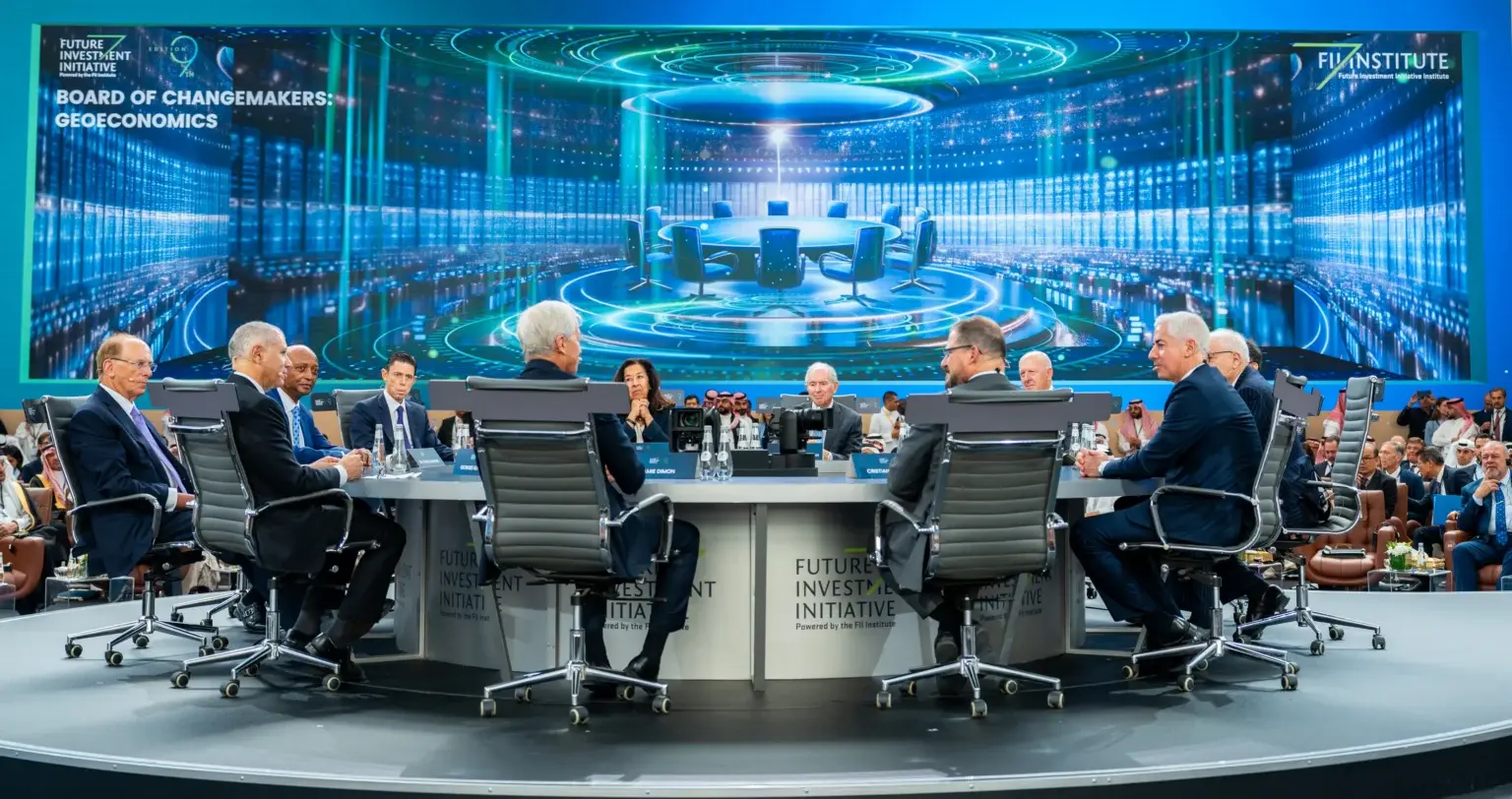
The conference kicked off with a powerhouse roundtable including global financial leaders JPMorgan Chase Chairman Jamie Dimon, Intel CEO Lip-Bu Tan, Goldman Sachs Chairman & CEO David Solomon, Pershing Square Founder & CEO Bill Ackman, Qualcomm President & CEO Cristiano R. Amon, BlackRock Chairman & CEO Laurence Fink, HSBC CEO Georges Elhedery, African Rainbow Minerals Founder & Executive Chairman Dr. Patrice Motsepe, KKR Co-CEO Scott Nuttall, Olayan Group Chair Lubna S. Olayan, and Blackstone Co-Founder, and Chairman & CEO Stephen A. Schwarzman. Moderated by Carlyle Co-Founder and Co-Chairman David Rubenstein, the group represented firms that collectively manage roughly $15 trillion. For perspective, that’s four to five times the entire GDP of the United Kingdom, underscoring just how much influence this group has on the direction of global markets. They set the tone for the week with a candid conversation about how technology and capital are reshaping global flows and market structures.
A notable takeaway was when Fink claimed that we were “at the beginning of the tokenization of all assets.” Instead of representing assets the traditional way, they can be converted into a digital token that enables instant ownership transfer, reduces counterparty and settlement risk, and reduces the need for intermediaries like clearinghouses. Therefore, flexibility and new possibilities are unlocked, allowing fractional ownership and broader investor participation.
Yet, Fink emphasized that this shift hinges on building a robust identity infrastructure, ensuring that transparency and security keep pace with innovation. Together, these changes signal not an incremental upgrade, but a fundamental re-architecture of how global finance operates. In short, tokenization rewires how assets are issued, traded, settled, and held, thus collapsing friction and redefining the financial market’s backend.
The deeper takeaway is that this shift is already underway, and its full implications remain unknown. As tokenization quietly reshapes the financial “plumbing,” it could redefine the roles of banks, payment networks like Mastercard and Amex, and even how we think about currencies such as the U.S. dollar. In other words, the future of finance isn’t waiting to arrive: it’s unfolding in real time.
Unlocking the Future: The Saudi Frontier
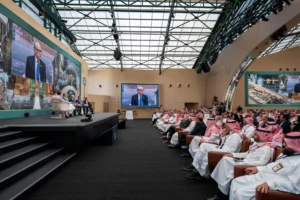
Finally, FII9 firmly established Saudi Arabia as a rising force in economic transformation, especially given the presence of 8,000+ global leaders, sovereign wealth funds, and Fortune CEOs, all in one place. Discussions around AI and Riyadh’s ambition to anchor regional and global flows of capital and talent make it clear that Saudi Arabia is positioning itself not only to cultivate ideas but also to convert them into tangible outcomes for sustainable global impact.
On a personal note, what stood out just as much as the scale was the warmth and pride of the people hosting us. Everywhere I went, the hospitality was genuine, and there was a clear sense of excitement about welcoming the world and contributing to what comes next. As I left Riyadh, my main takeaway was that FII has become a true pulse check on where technology, capital, and policy are converging, all at once. This year reinforced that the frontier of innovation is unfolding in real time, driven by people and places ready to lean into the opportunity.