Podcast: Play in new window | Download
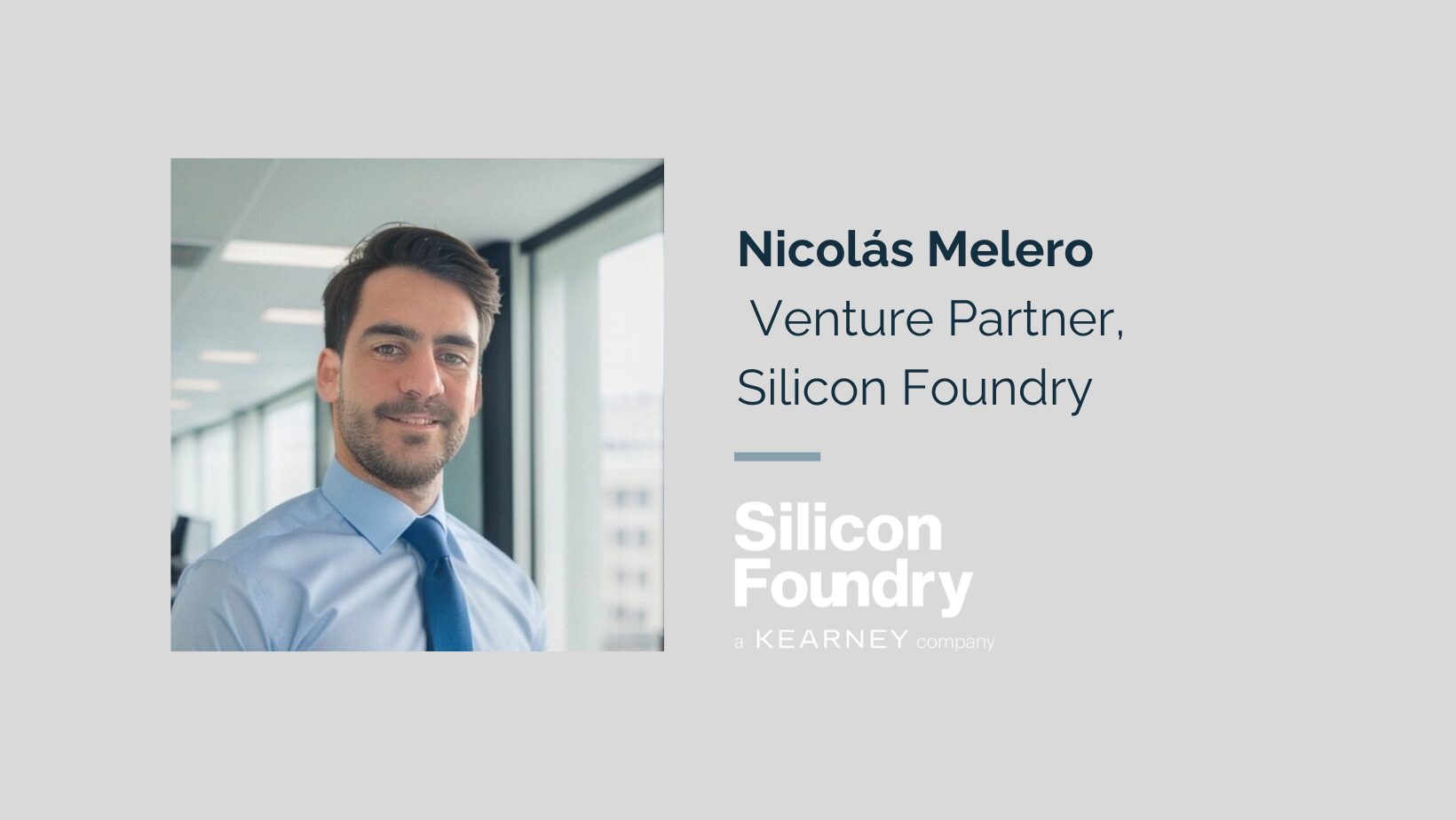
We’re pleased to welcome our newest Venture Partner, Nicolás Melero, former Head of Digital Partnerships and Innovation at Falabella. Today, Nicolás works with corporate leaders and investors to design build–partner strategies, connect with startups, and scale innovation with measurable impact, while simultaneously pursuing his MBA at the MIT Sloan School of Management. At Silicon Foundry, Nicolás will work closely with leaders in corporate innovation and venture capital to continue turning emerging technologies and partnerships into scalable business outcomes with clarity.
We sat down with Nicolás about building disciplined corporate venture platforms, designing scalable pilots, and strengthening innovation pathways across Latin America.
Press play to listen to this conversation
What was the moment or experience that first drew you toward venture strategy and innovation, and how did that lead you to your work with Falabella Ventures?
Across my career, I have been deliberately trying to become a better investor. For me, a good investor can answer two questions with clarity: why am I investing, and what is the purpose of this investment. The path I chose to answer those questions better was information. In venture capital, better information improves judgment under uncertainty and tends to improve returns. In corporate venture capital, there is a second layer, because you are also accountable for strategic value to the corporation.
That is what drew me to venture strategy and innovation. It is where you build an information edge by sitting close to real operating problems and real customers, and where you can connect a technology decision to a clear business outcome and a realistic path to adoption. Warren Buffett has a line I have always found directionally useful: “Risk comes from not knowing what you are doing.” I try to take it modestly, as a reminder that clarity and understanding reduce downside.
At Falabella Ventures, we tried to make that discipline a habit. We were explicit about the why and the purpose behind each investment, what evidence would validate it, and what had to be true for scale. That clarity helped us make better decisions and deliver a strong track record.
When you look back at your time at Falabella Ventures, what enabled the team to consistently get into high-quality rounds and build that reputation for disciplined investing and corporate integration?
A big part of our success came from combining global ambition with real operating discipline. We wanted to connect the company with the best talent globally, participate in the strongest rounds in the region, and co-invest alongside world-class funds. We earned the right to do that by being consistent and rigorous in how we selected, diligenced, and integrated startups.
We used a simple framework to stay disciplined: the 6Ts, which stand for Team, Target Market, Traction, Technology, Terms, and Together. Team and Target Market set the foundation. Traction showed evidence of pull. Technology was not just the product, but scalability, reliability, and how it would hold up inside an enterprise environment. Terms kept us honest on valuation and structure. Together forced the strategic questions: why this company, why now, and why should we be the right partner.
Governance also mattered. Investments were decided by majority vote at the investment committee, and we required a business sponsor. That created real accountability and made integration much more likely, because someone in the business owned the outcome.
We also ran rigorous technical diligence, especially on scalability and integration readiness. And importantly, we often invested after working together for a while. The partnership came first, then the investment followed once we had evidence that the solution could deliver value in our context. That combination, clear evaluation criteria, strong governance, deep diligence, and patience on timing, is what built credibility with both top founders and top co-investors, and helped us build a strong reputation in the market.
From your experience inside a global retail organization, what structural factors ultimately determine whether corporate venture becomes a growth engine versus a symbolic initiative?
In my experience, whether a corporate venture becomes a growth engine or a symbolic initiative comes down to two pillars: culture and strategy.
First, culture. You need an organization where people are genuinely eager to innovate, improve continuously, and surprise the customer by creating value. When that mindset is widespread, corporate venture is not “a separate team doing experiments.” It becomes a channel the business actively uses to move faster, solve real problems, and raise the bar. In that environment, pilots get pulled into the organization and scaled because teams want them to work.
Second, strategy. Corporate venture needs to be tightly linked to the company’s strategy and to the real short and long-term bets. The team has to understand what the business units are trying to achieve, then act as an ally that helps them deliver those bets through partnerships, pilots, and investments. When a corporate venture is aligned with strategy, incentives align across stakeholders, collaboration becomes easier, and results start to compound. That creates a reinforcing loop where each successful initiative builds credibility, increases internal demand, and improves the odds of the next initiative scaling.
Through your work on boards and investment committees across fintech and deeptech companies, you’ve seen both operating urgency and capital discipline up close. How do you balance near-term performance expectations with long-term strategic bets?
Serving on boards and investment committees gives me both an operating lens and a capital allocation lens, and it has made me much more intentional about time horizons. I reconcile short-term pressure and long-term positioning by being explicit about horizons and by protecting a small set of longer-term bets with the right governance. Some initiatives must deliver near-term impact. Others build capabilities that matter in the next planning cycle. A smaller set creates long-term options. When you are clear about which bucket you are in, you can align governance, metrics, and resourcing with the goal.
Boards also teach you to prioritize and to say no. In corporate venture, it is easy to get excited quickly, because the ideas are genuinely interesting. The director and investment committee have forced discipline. It pushes you to focus on the few initiatives that have the strongest rationale, the clearest path to adoption, and the highest potential impact, and to say no to many good ideas so you can execute great ones.
Many corporations struggle to connect venture investments to measurable operating impact. What governance or structural mechanisms have you seen work best to translate external innovation into internal value creation?
The best mechanisms are simple, repeatable, and anchored in how the business already operates. First, a clear venture-to-business interface. Every pilot has an internal owner, an executive sponsor, and a working team that executes. Second, a standard pilot design with a scoreboard. You define the baseline, the target KPI, the timeline, and what success looks like. Third, a growth board that meets regularly and makes decisions. Not updates, decisions. Such as what advances to scale, what needs iteration, what stops, and what needs executive help. Finally, many organizations underestimate implementation capacity. You need people who can integrate, deploy, and drive adoption across business units.
Where do you see the biggest structural bottlenecks in the LATAM innovation ecosystem, and what would unlock the next wave of scale?
The biggest bottleneck is the path from innovation to scale. The region has great talent and more early-stage capital than it did a decade ago, but many great solutions still stall when they meet enterprise reality: procurement, risk, data access, and implementation capacity.
What unlocks the next wave is a stronger operating infrastructure on both sides. Corporations need a repeatable partnership model that moves fast while managing risk. Startups need stronger enterprise execution muscles: implementation, customer success, and the ability to expand across countries with different regulations and systems.
The second bottleneck is fragmentation. Cross-border growth in LATAM is rarely plug-and-play. Regulatory frameworks vary by country, making it significant to build a playbook for integrations and regulatory navigation. There are not many economies of scale coming from internationalization in LATAM. If those two areas improve, conversion rates from pilot to scale will jump, and the ecosystem will compound faster.
As a Venture Partner at Silicon Foundry, where do you think you can create the most leverage, and what will you focus on first?
I see the greatest opportunity at the intersection of ecosystem intelligence and cross-market connectivity, with a strong bias toward outcomes. Silicon Foundry has a unique position: deep access to emerging technologies and trusted relationships with corporate leaders who can deploy them at scale.
My focus is to help corporates make sharper build-or-partner decisions, then move quickly from insight to action. That includes translating technology into business cases leaders can act on, designing pilots that are built to scale, and connecting the right internal stakeholders to the right founders.
The second focus is pattern recognition across markets. When you sit across industries and geographies, you start to see repeatable playbooks for governance, adoption, and scaling. Capturing those patterns and turning them into repeatable playbooks is a force multiplier.