Podcast: Play in new window | Download
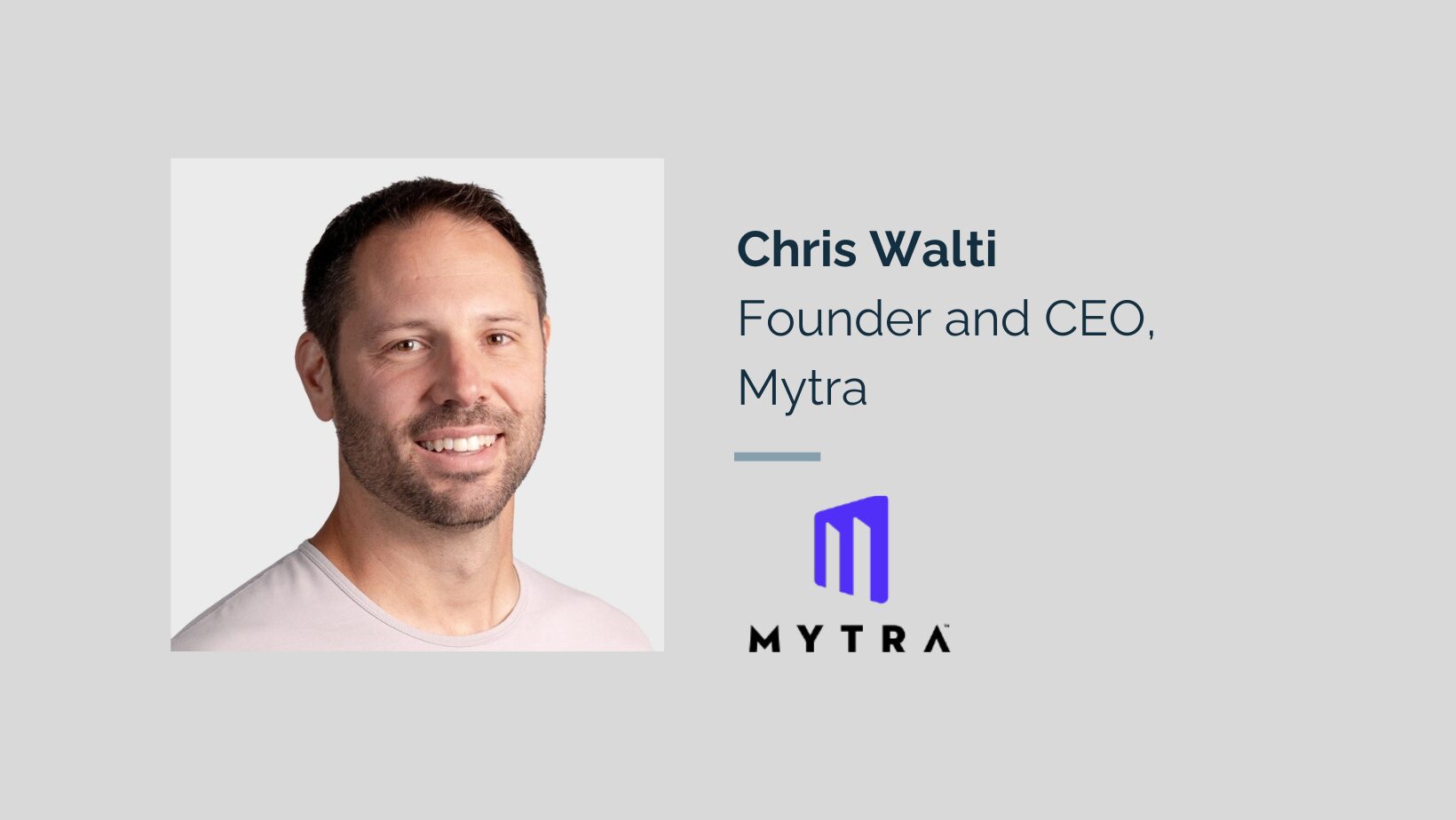
We sat down with Chris Walti, Founder and CEO of Mytra, a company building next-generation warehouse and manufacturing infrastructure to modernize how materials are stored and moved. Mytra applies robotics and modern software-driven intelligence to create a resilient, modular, and reconfigurable material flow and storage system, enabling goods to be dynamically stored, moved, and retrieved without custom integration code or fixed layouts.
Founded by an exceptional team with backgrounds at Tesla, Rivian, Boeing, and Walmart, Mytra was built to address a persistent operational gap: while planning software and analytics have advanced rapidly, the physical movement of materials inside facilities has remained rigid, labor-intensive, and difficult to adapt as business needs change. The company’s board includes the former CFO of Tesla, Zach Kirkhorn, adding deep financial and operational experience as Mytra scales across warehouse and manufacturing environments where uptime and flexibility are critical.
Now moving from pilot to production, Mytra has raised a $120 million in Series C led by Avenir Growth Capital and is working with Fortune 100 customers (incl. Albertsons), with its first enterprise rollout completed in early 2024.
We recently sat down with Chris to discuss next-generation warehouse and manufacturing infrastructure.
Press play to listen to the conversation
What experiences across working with a team from Tesla, Rivian, Boeing, and Walmart made it clear that material flow was the problem worth solving, and why did it require a fundamentally new approach?
The origin of Mytra really comes from this layered set of experiences. For my part, I spent those eight years at Tesla, and a big chunk of that was wrestling with the material flow system for the Model 3 general assembly line. It was a real tangle of legacy automation, including multiple disparate systems, a ton of single points of failure, and a structure that just wasn’t designed for the kind of flexibility and agility we needed. We spent months trying to fix it, and that really drove home that this wasn’t just a local Tesla problem. It was a fundamental industry issue.
In parallel, I also led the mobile robotics team and the humanoid program, building some of the most state-of-the-art robotics in the industry. And that gave me this dual perspective: on one hand, we had all this cutting-edge robotics capability; on the other, we were still struggling with the same old rigidity in material flow. And it became obvious that the solution wasn’t to add more complexity. It was to rethink the system entirely.
And this wasn’t just my realization. Our founding team brought in folks from Rivian, Walmart, and Boeing – all from different industries that faced the same challenge. They’d all seen that the industry wasn’t looking for more sci-fi robots or more complex automation. Instead, the big “aha” moment was that we needed to re-architect the system with simpler, more primitive building blocks that were software-driven and flexible.
In other words, I learned that the future of material flow isn’t about the fanciest robot; it’s about making the entire flow architecture fundamentally more adaptable. And that’s the core idea behind Mytra. We took all those lessons from different environments and realized that the industry needs a simpler, software-defined approach to stay flexible and resilient.
If the gap between advanced robotics and inflexible material flow has been clear for years, why has the industry struggled for so long to make material movement more adaptable, even with massive automation investment?
The core reason is that the industry just hasn’t had that systems-level rethink yet. If you look at sectors like automotive, aerospace, or even defense, they all had their own moments of transformation when someone came in and said, “We need to rethink this from the ground up.” But in material flow, a lot of the automation is still very customized, very one-off, and not productized. Every warehouse is a bit of a snowflake. And that means even within the same company, you might have different automation systems in different facilities, different PLCs, different actuators. It’s all incredibly fragmented.
The analogy I like to use is that it’s like the early days of computing. Everyone uses their devices differently, but the hardware is basically the same, and the flexibility comes from the software layer. In logistics and manufacturing, we haven’t reached that point yet. Designing simple, standardized systems is actually one of the hardest things to do, and it requires a new mindset.
So in short, material flow is still broken because the industry hasn’t had that big re-architecture moment yet. But that’s changing now. Just like Tesla rethought automotive, or SpaceX did for space, we’re bringing that same kind of systems thinking to logistics. And that’s what Mytra is all about: turning what used to be a snowflake problem into a standardized, software-driven solution that can finally adapt and scale.
Moving from pilots to production with Fortune 100 customers, what tends to break when next-generation automation meets live, high-throughput operations?
Well, if you look at the industry track record, even introducing a new WMS into a facility can take six to twelve months before it really hits its stride. The norm is that new technology doesn’t just work perfectly out of the box. What we’ve seen at Mytra is that you have to design for adaptability from day one. In our very first customer project, we didn’t just get the system up to the service level agreement quickly; within about a month and a half, we were exceeding that SLA by roughly three times the throughput. How? By making it all about software-driven flexibility. Instead of relying on hardware tweaks that can take weeks or months, we could identify an issue, push a software fix, and have it live the same day. That’s the agility that’s been missing.
Another big piece is bringing the people on the ground into the loop early. We spent a lot of time understanding the operators’ needs, listening to forklift drivers, and making sure they were part of the journey. It’s amazing how often new automation is designed in an ivory tower without talking to the actual users. We flipped that script, and that human-centric approach made a huge difference.
In the end, what tends to break is the assumption that you can plan for perfection from day one. You simply can’t. But you can design for rapid iteration, you can make software the backbone of flexibility, and you can treat the people on the floor as partners rather than afterthoughts. That’s how you get from pilot to production without everything falling apart.
When you’re in the room with executives considering Mytra, what usually lands hardest for them in the business case—labor savings, better use of space, throughput gains, or resilience?
When executives evaluate Mytra, they often come in looking for very tangible business cases. And if we’re honest, the two metrics that almost always underwrite the investment are labor efficiency and space utilization. In other words, can we do more with the same or less labor, and can we use our warehouse or factory space more effectively? Those are the clear ROI drivers everyone understands from day one.
But what we find is that Mytra isn’t just about being a point solution. We want to be the strategic partner that helps them build a flexible, resilient system of record for their automation. And over time, as they begin to see those labor and space benefits, they also start to realize the value of flexibility and resilience. At first, those can be harder for them to quantify. But once they see how quickly they can adapt to new demands, reconfigure flows, or scale up capacity without a huge new hardware project, that becomes a big part of the business case too.
In short, we lead with labor and space because that’s easy to measure. But over time, our customers start to see that the real magic is in having a system that can change as fast as they do. And that’s where Mytra really stands out.
In practice, where do large organizations still underestimate the operational change required?
So when it comes to integration and change management, we do emphasize that Mytra’s approach requires no custom integration code. That definitely reduces the friction on the IT side. But one of the big values of our system is that it also lowers the amount of human change management needed. In a traditional warehouse, if you introduce a new slotting approach or a new routing method, there’s a lag. People have to relearn the process, get used to new tasks, and that can slow things down.
With Mytra, because we modularize and simplify the human tasks, the change is a lot easier. We break down complex workflows into simpler building blocks. So if you know how to handle a case, you don’t have to master a whole new routing scheme suddenly. We’re basically making human tasks more consistent and less sensitive to operational changes. That means the workforce can adapt faster and with less disruption.
On the IT side, while we do remove a lot of the integration headaches, we’ve found that the real focus ends up being on security and compliance. Our customers’ logistics data is incredibly valuable and sensitive, so a lot of the deeper integration work is actually about making sure we meet all their security protocols and that the handoff is as frictionless as possible.
In short, the big surprise for large organizations is that while the tech integration is straightforward, the real win is that we reduce the human change burden too. By making human roles simpler and more modular, we make the whole transition smoother and faster. And that’s a huge part of the value we bring.
If the system is doing more of the orchestration in software, what does that mean for the people on the floor day-to-day? How does a software-defined material flow system change its role?
So when we talk about how a software-defined material flow system changes the role of people on the warehouse or factory floor, one of the fundamental shifts is in reducing those physically grueling, injury-prone tasks. Having spent a lot of time in factories and warehouses, we know that material handling often leads to some of the toughest and most injury-prone jobs. Repetitive strain, heavy lifting, and constant maneuvering of loads can take a real toll on the human body.
What Mytra does is shift that dynamic. We take those zero-value-add tasks—just moving things from point A to point B—and we let the software and automation handle that. That frees up the human workers to focus on tasks that are less repetitive and physically punishing. Instead, they can handle more nuanced, dexterous, or higher-value tasks that require human judgment, creativity, and problem-solving.
In other words, we’re making the work more interesting and less about brute labor. It’s not just about efficiency; it’s also about making the workplace safer and more engaging. When you remove the heavy, repetitive strain and let humans do the things humans are best at, you not only reduce injuries, you also create a more fulfilling job environment. That’s a huge shift in the role of people on the floor, and it’s a big part of the value that a software-defined material flow system brings.
Finally, five years from now, what about warehouse and manufacturing automation will feel obvious, but still isn’t widely understood today?
So if we think about five years from now, what’s going to feel obvious in warehouse and manufacturing automation, but maybe isn’t widely understood today, is just how much more efficient and dynamic the entire supply chain can become. Right now, we have a lot of waste, a lot of touches, and a lot of inefficiency built into logistics. The average product might go through half a dozen touch points before it gets to you, and there’s so much buffer inventory just sitting around. That’s GDP locked up in warehouses instead of being in the hands of consumers.
In the next five years, it’s going to become obvious that by putting software in the loop—by making each node in the supply chain smarter and more autonomous—we can cut down on that waste dramatically. We’ll start treating material flow a lot more like information flow on the internet—more agile, more flexible, and with far less waste and downtime.
And as we look even further out, maybe ten years, we’ll see things like autonomous trucking become the norm, and that’ll be a huge inflection point. Suddenly, the cost of moving smaller loads goes down, and logistics becomes more like a network of smaller, faster, more responsive nodes. Warehouses and factories that can adapt quickly will thrive in that environment.
In the end, what’ll feel obvious is that a software-defined supply chain isn’t just a nice-to-have; it’s the key to reducing waste, lowering costs, and making the whole system more sustainable and responsive. And that’s the future we’re excited to help build.