Podcast: Play in new window | Download
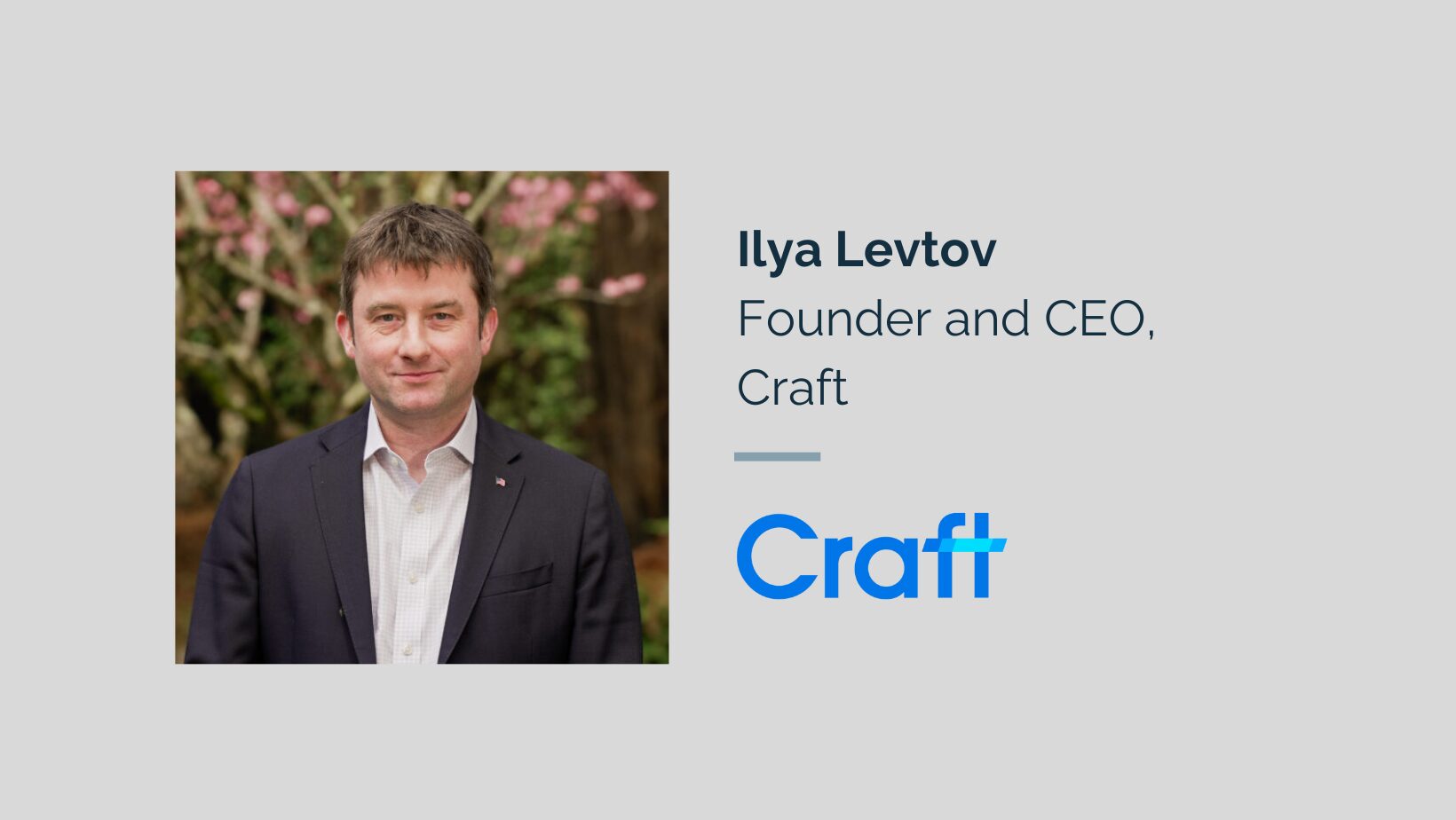
We recently sat down with Craft Founder and CEO Ilya Levtov, a longtime operator in Silicon Valley who spent years working in venture capital and wrestling with a fundamental problem: critical information about corporations was scattered, incomplete, and unreliable. For investors and operators alike, it was difficult to assess a company’s health, benchmark competitors, or understand supply chain exposure. That frustration ultimately pushed Ilya to build something better. What began as an effort to create a holistic and trusted source of truth for the data necessary to source and guide strategic investments has since grown into a leading supplier intelligence platform used by global enterprises and U.S. federal agencies. Today, Craft combines multi-sourced datasets, agentic AI, and human validation to provide organizations with a real-time view into supplier risk, resilience, and performance at a scale previously impossible.
Press play to listen to this conversation
Before Craft became the platform it is today, you were on the other side of the table, dealing with messy, unreliable data. What was the pain point that convinced you it was time to build a better solution?
When I founded Craft, I was coming out of a 15-year career in business development and finance roles in Silicon Valley and various technology companies. During that entire time, I found myself hunting for company information almost every day, whether I was buying from a company, selling to them, investing in them, or evaluating a potential partnership.
To me, the experience was almost always frustrating. The data was always missing, outdated, inaccurate, or simply unavailable. So, I began to wonder: Could there be a better way?
Could we build for companies what Zillow and Trulia built for homes, or what Yelp built for restaurants—a reliable source of truth?
That idea became the foundation of Craft. We started by building crawlers and scrapers to gather data directly from company websites—homepages, “About” pages, job listings, management team profiles, pricing pages, and more. Then, we cleaned it up and built real company profiles. The demand was almost immediate, and soon, we were appearing in more than 100 million organic search results per month, all without paid marketing.
Over time, we saw that procurement and supply chain teams across both large enterprises and government agencies were using Craft to understand and monitor hundreds of thousands of suppliers at once. That discovery reshaped our focus entirely, and we’ve been dedicated to serving supply chain and procurement leaders ever since.
Craft’s platform ingests internal and external data to surface supplier risk insights. In simple terms, how does your data intelligence engine work end-to-end, and how do you keep insights timely and accurate?
Craft has evolved tremendously from those early days of basic scrapers. One of the biggest steps forward was forming partnerships with best-in-class specialty data providers covering cybersecurity, ESG, financials, media, reputation, and other key categories. In many cases, we work with multiple high-quality partners for the same category to ensure accuracy and coverage.
We blend those external sources with extensive native data collection, which over the last few years has become agentic. Today, AI agents continuously gather and interpret publicly available data, which we merge with our partner datasets to create a highly validated, multi-sourced data fabric.
We also rely on an exceptional human-in-the-loop team to verify and refine data. That combination of AI scale, specialty partnerships, and human validation ensures Craft’s insights are both comprehensive and trustworthy.
With $42 million raised across your Series A and B, what strategic priorities are you focused on—technology, market expansion, talent, or partnerships?
We’re now fully in the era of AI, and our top investment priority is the evolution of our intelligent workspace—our AI-first product. It is what takes Craft from a powerful database into an immersive, end-to-end workspace for procurement and supply chain teams. This product fundamentally changes how enterprises qualify suppliers, assess risk, and perform continuous monitoring across their entire supplier network. AI is the key to unlocking that transformation.
Beyond product innovation, we’re investing heavily in sales and marketing in order to broaden awareness of Craft, engage prospective customers, and equip our team with the tools needed to bring those customers on board.
Craft became a crucial resource during the COVID-19 supply chain crisis. What were the biggest lessons from that period, and how did it shape your long-term vision?
The pandemic exposed how brittle global supply chains truly were. Years of “just-in-time” manufacturing, offshoring, and heavy dependence on China and Asia created extreme fragility. In those early months, supply chains all but collapsed, and the world felt the consequences, down to basic necessities disappearing from store shelves.
Even after the initial crisis passed, organizations realized that deeper structural issues still remained, such as an overreliance on overseas suppliers, fragile shipping routes, and volatile shipping and oil prices, ESG concerns like forced labor and environmental violations, and ever-persistent cybersecurity risks within supply chains
COVID-19 was the catalyst, but the wake-up call continued long after. The positive outcome is that enterprises and government agencies have remained focused on building and maintaining supply chain resilience, and Craft is now deeply aligned with that mission.
You noted earlier how teams were spending entire days compiling supplier risk reports before Craft. Where have you seen Craft drive the most measurable impact—time saved, risk reduced, or operational efficiency?
I would say the most immediate impact is time savings. Many customers previously spent 8 hours manually researching and preparing a supplier risk report. However, we brought that down to 1 hour, and with the intelligent workspace, it now takes about a minute to generate a comprehensive, validated assessment.
The second major impact is risk reduction. Across large supplier networks, Craft typically uncovers previously unknown material risks in 15–24% of suppliers in any given product line. That early detection allows supply chain leaders to mitigate issues long before they become disruptions.
Supply chain and procurement teams face immense pressure today. How has the definition of supply chain resilience evolved since you founded Craft, and where is it heading next?
Definitely one of the most important shifts is from point-in-time monitoring to continuous monitoring. 80% of supply chain risks emerge after onboarding, which highlights the need for ongoing visibility rather than annual check-ins.
But frequency is only part of the transformation. The scope of risk assessment has expanded dramatically. Traditional checks focused almost exclusively on financial health. Today, organizations must evaluate cybersecurity posture, environmental and social responsibility, geopolitical exposure, climate and location risks, and shipping route vulnerabilities.
In many cases, these alternative signals outperform traditional credit ratings in predicting future instability. The future of resilience is truly 360-degree, continuous, multi-signal monitoring.
Outside of continuous monitoring, what is Craft’s core differentiator versus legacy tools or newer market entrants?
Our greatest differentiator is our data fabric—the breadth, depth, and validated quality of our data. It combines high-scale AI, multi-sourced datasets, and human verification in a way that no other player matches. On top of that foundation sits our AI-first intelligent workspace, introduced in late 2024 and expanded throughout 2025. It enables enterprises to qualify suppliers 80% faster than before and to continuously and comprehensively monitor their supply chains.
Together, these capabilities deliver tremendously powerful and actionable insights that transform how organizations manage suppliers and risk.
Hearing the full arc of Craft’s journey, from a simple idea about reliable company data to a platform supporting federal agencies, what has been one of the most defining moments for you so far? And as you look ahead, what should we expect next?
The entrepreneurial journey has been so exciting and at the same time, deeply unpredictable. I think it’s extremely rewarding that there’s a new problem to solve every day. Craft’s path from a general source of truth on companies to a leading supplier intelligence platform has been nonlinear, but incredibly worthwhile.
Building this team of exceptional, diverse, passionate individuals has been one of the greatest privileges of my career. And seeing the real impact we have on customers, especially across the U.S. federal government, is profoundly meaningful.
Looking ahead, our focus is on continuing to elevate the intelligent workspace and expanding the impact we deliver to global supply chains. We’re just getting started.